What every effective sales proposal template needs
Ready to go digital?
Discover how Zoomforth can help you.
Join 500+ enterprise sales, marketing and HR teams building trackable microsites — no developer needed.
Rated 4.76/5 on G2 · Trusted by Fortune 500 teams
Thanks — we've got your request.
Check your inbox — Wendie has sent her calendar link.
While you wait, browse real microsites in our microsite inspiration gallery or learn the basics in the Zoomforth Academy.
The best proposal templates share a consistent structure: they lead with the buyer's problem, not the seller's company history. They build the case through evidence before they make the ask. And they close with a specific, time-bound next step — not an open invitation to get in touch whenever convenient.
The sections below are the non-negotiables for any B2B proposal template. The order matters as much as the content.
| Section | Purpose | Template vs custom? |
|---|---|---|
| Cover page | Establish identity and context immediately | Template (design); custom (buyer name, date, deal reference) |
| Executive summary | State the buyer's problem and your proposed solution in one page | Always custom — write this fresh for every buyer |
| Problem statement | Prove you understand the buyer's challenge | Mostly custom — use the buyer's own language from discovery |
| Proposed solution | Describe what you are going to do and why | Template structure; custom framing for this buyer's context |
| Scope of work | Define exactly what is included and what is not | Template structure; custom content for this engagement |
| Pricing | Present the investment clearly, framed around value | Template structure; custom line items and totals |
| Timeline | Show when things happen and what the buyer needs to provide | Template structure; custom dates and dependencies |
| Team | Introduce the people who will do the work | Custom — show the actual delivery team for this engagement |
| Case studies / references | Provide evidence from comparable clients | Select from template library based on industry and challenge match |
| Next step | Tell the buyer exactly what to do next | Always custom — specific action, named contact, date |
8 B2B sales proposal templates by use case
Each template below describes the structure, the customisation priorities, and the sections that most often determine whether the proposal wins or loses.
Template 1: enterprise software proposal
Best for: Technology companies selling SaaS or software platforms to enterprise buyers. Typically 10–25 pages.
Structure: Executive summary → Technical solution overview → Implementation and onboarding plan → Security and compliance → Integrations → Pricing (licence + implementation + support) → Team → Case studies → SLAs and support commitments → Next step.
Customisation priorities: The technical solution section should reference the buyer's existing technology stack. The security and compliance section should address the specific certifications the buyer's procurement checklist requires. Case studies should be from the buyer's industry or a comparable company size.
Common mistake: Burying the implementation plan. Enterprise software buyers have been burned by implementations that ran over time and budget — address this proactively with a realistic, phased timeline and clear milestones.
Template 2: professional services proposal
Best for: Consulting, agency, or professional services firms proposing a specific engagement. Typically 8–20 pages.
Structure: Executive summary → Situation and objectives (restating the buyer's brief) → Proposed approach and methodology → Deliverables and timeline → Team (lead consultant + supporting team) → Relevant experience → Investment (fees by phase or deliverable) → Next step.
Customisation priorities: The proposed approach section must be specific to this engagement — not a copy of a previous project's methodology. The team section is critical in professional services, where buyers are buying people as much as they are buying capability.
Common mistake: Generic methodology descriptions. "We use a four-phase approach: discovery, design, delivery, and debrief" tells the buyer nothing specific. Every consulting firm says something equivalent. The proposal wins on specificity.
Template 3: RFP response proposal
Best for: Formal RFP responses submitted through a procurement process. Structure is often dictated by the RFP itself.
Structure: Follow the RFP's required section order. Add an executive summary if the RFP allows it (many do, and most competitors omit it). Include a compliance matrix as a front matter table showing exactly where each RFP requirement is addressed.
Customisation priorities: The compliance matrix and the executive summary. The compliance matrix saves the evaluation committee time and demonstrates that you read the RFP thoroughly. The executive summary sets the frame for everything that follows.
See the full guide: how to respond to an RFP.
Template 4: marketing agency proposal
Best for: Agencies proposing a retainer, a campaign, or a project to a marketing buyer. Typically 8–15 pages.
Structure: Brief recap → Strategic approach → Campaign or retainer structure → Deliverables by month or phase → Team and account structure → Measurement framework → Investment → Case studies → Next step.
Customisation priorities: The measurement framework section. Marketing buyers are accountable for results — show specifically how you will measure the outcomes they care about (not just the outputs your agency delivers). The case studies should show comparable campaigns with specific metrics.
Template 5: financial services engagement proposal
Best for: Proposals to financial services buyers where compliance and regulatory context are primary evaluation criteria.
Structure: Executive summary → Regulatory and compliance context → Proposed solution → Security architecture → Implementation and risk management → Team → References from comparable institutions → Pricing → Next step.
Customisation priorities: Lead with compliance. The security architecture and regulatory context sections belong near the top, not in an appendix. Financial services buyers evaluate risk before they evaluate value — the proposal structure should reflect this.
Templates 6–8: additional use cases
Template 6 — IT and infrastructure proposal: Leads with the technical architecture, integration requirements, and data migration plan. The business case section translates technical decisions into operational outcomes for non-technical executive sponsors. Security and compliance are prominent throughout.
Template 7 — HR technology proposal: Covers implementation and change management in detail — HR technology deployments touch every employee, and buyers want to see a specific adoption and communication plan. The team section includes the implementation lead and the ongoing support model post-launch.
Template 8 — Strategic partnership proposal: Less focused on deliverables and more focused on alignment: shared goals, proposed governance structure, mutual commitments, measurement of partnership success, and a clear escalation path. Pricing is often secondary to the partnership terms.

How to customise a proposal template effectively
The difference between a templated proposal that wins and one that loses is how well the customisation reflects genuine understanding of the buyer's specific situation.

Always rewrite the executive summary
The executive summary is the one section that should never be templated. Write it fresh for every buyer, using their own language from discovery conversations. Buyers who recognise their own words in the first page know immediately that you listened — which is the foundation of trust in a competitive bid.

Select case studies by industry, not by recency
The most common case study mistake is showing the most recent work rather than the most relevant work. A financial services buyer cares about your financial services experience, not your most recent retail client. Maintain a categorised library of case studies so you can pull the right ones for each proposal without starting from scratch.

Frame pricing around value, not cost
Every pricing section should include at least one metric that connects the investment to a business outcome: time saved, risk reduced, revenue at stake, cost of the alternative. "£85,000 per year" is a number. "£85,000 per year — equivalent to the cost of one analyst role, with the output of a team of five" is a business case.

Make the next step specific and easy
The final page of the proposal should remove all ambiguity from what happens next. Name the person the buyer should contact, provide their direct phone and email, suggest a specific date for a follow-up call, and if possible, include a link to book directly. The more specific the next step, the more likely it is to happen.
Static proposal template vs interactive proposal microsite
A template solves the creation problem. An interactive proposal microsite solves the delivery problem — what happens after the proposal is sent and the buyer reviews it without you in the room.
Know who read what
A static PDF tells you nothing after it leaves your hands. An interactive proposal microsite tells you which stakeholders opened it, which sections they spent the most time on, and whether they returned for a second review. This data changes every follow-up conversation — you can open the call already knowing where the buyer's attention is focused.

Update after sending
When a buyer raises a new requirement or a pricing concern after receiving the proposal, you can update the microsite the same day — and the link they already have reflects the change immediately. No re-sending, no version confusion, no risk of the buyer sharing an outdated version with a colleague.

Control access
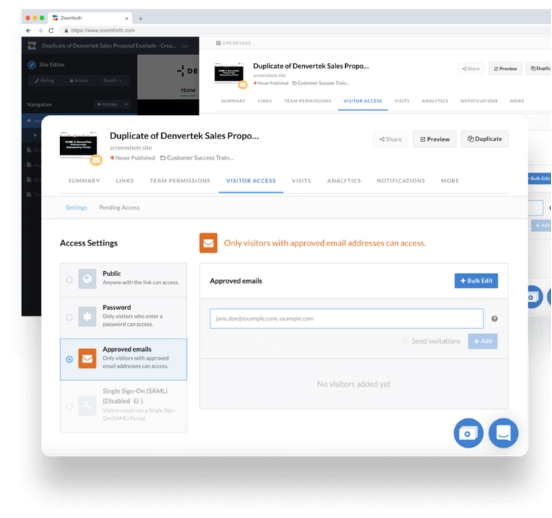
Proposal content is commercially sensitive. An interactive proposal microsite can be access-controlled — password-protected, restricted by email domain, or secured with SSO — so only the intended stakeholders can view it. You maintain control of the content even as it travels through the buyer's organisation.
Works on any device
Buyers review proposals on phones and tablets during commutes and between meetings. A proposal that requires downloading a PDF and zooming in on a mobile screen is losing the battle for attention before the reader has read the first paragraph. A responsive microsite reads cleanly on every device.
Turn your proposal template into an interactive proposal
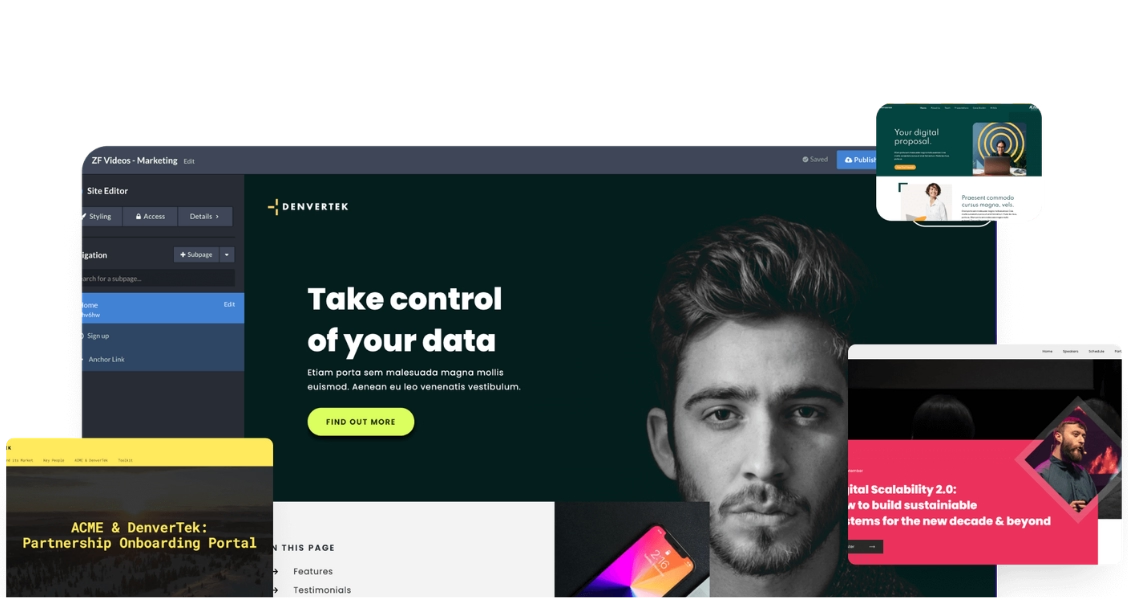
Zoomforth lets enterprise sales teams build trackable, branded proposal microsites from a template — without developers or designers. See how it compares to sending a PDF.
Request a demo
Frequently asked questions about sales proposal templates
What should a sales proposal template include?
A complete sales proposal template should include an executive summary (the buyer's problem and your proposed solution in one page), a detailed solution section, a scope of work or deliverables breakdown, a pricing section with clear line items, a timeline or implementation roadmap, a team section, references or case studies from comparable clients, and a clear next step or call to action.
How do you customise a sales proposal template?
Effective customisation focuses on the sections that should be account-specific: the executive summary (always rewritten for the buyer's specific situation), the solution section (framed around this buyer's problem), the case studies (selected to match the buyer's industry and challenge), and the team section. Sections that can remain templated include pricing structures, standard scope descriptions, and company background.
What is the difference between a proposal template and a proposal microsite?
A proposal template is a document structure that you fill in for each new proposal. A proposal microsite is an interactive web experience that delivers the same content through a branded, trackable web page rather than a static document. Microsites show you who read the proposal and which sections they spent the most time on, can be updated after sending, and work on any device without formatting issues.
How long should a B2B sales proposal be?
A B2B sales proposal should be as long as needed to answer the buyer's questions and no longer. For small-to-medium engagements, three to six pages is typical. For large enterprise or government contracts, fifteen to thirty pages or more may be expected. The structure matters more than the length: a concise, well-organised ten-page proposal almost always outperforms a padded twenty-page document.
Related resources
RFP response guide
Everything B2B sales teams need to know about RFPs — what they are, how to structure a winning response, and why the best teams have moved beyond the PDF.
Business proposal examples
Real B2B business proposal examples organised by deal type and industry — with analysis of what makes each one work for the specific buyer context.
One-pager templates
When the deal calls for something shorter than a full proposal — ready-to-use one-pager templates for quick sends and early-stage outreach.
Sales microsite examples
Browse real interactive proposals, RFP responses, and account portals built with Zoomforth — and see why teams are moving beyond the static PDF proposal.