
What is an RFP and why does it matter for your sales team?
Ready to go digital?
Discover how Zoomforth can help you.
Join 500+ enterprise sales, marketing and HR teams building trackable microsites — no developer needed.
Rated 4.76/5 on G2 · Trusted by Fortune 500 teams
Thanks — we've got your request.
Check your inbox — Wendie has sent her calendar link.
While you wait, browse real microsites in our microsite inspiration gallery or learn the basics in the Zoomforth Academy.
A Request for Proposal (RFP) is a formal document issued by a company or organization to solicit bids from potential vendors for a specific project, service, or product. In the B2B world, RFPs are the standard way large enterprises evaluate complex solutions, ensuring they find the best fit for their technical, financial, and strategic needs.
For sales teams, an RFP is more than a questionnaire — it is a competitive stage where your value proposition must shine through hundreds of data points. Winning an RFP requires balancing compliance (answering every requirement) with persuasion (showing why you are the better choice).

Winning an RFP isn't about being the "best" company on paper. It's about being the company that most clearly demonstrates it understands the buyer's problem.
The traditional RFP process is difficult by design. Buyers receive dozens of nearly identical responses and struggle to differentiate vendors. That creates a real opportunity for sales teams that invest in a more engaging, trackable, and visually compelling format.
This guide covers the full picture: the terminology, the anatomy of a winning response, the four steps that separate winners from the rest, and why the world's leading enterprise sales teams have moved their RFP responses from static PDFs to interactive microsites.
See a winning RFP microsite
Browse real examples of RFP response microsites built by enterprise sales teams using Zoomforth.
View examples
RFP vs RFI vs RFQ: understanding the three formats B2B buyers use
Before you commit your team's time to a response, you need to know exactly what type of document you are dealing with. Buyers use different formats depending on their stage in the buying cycle — and confusing them is an avoidable mistake.

RFI (Request for Information): Used in the discovery phase. The buyer is "just looking" and gathering broad market information. Low stakes — high volume.
RFP (Request for Proposal): The heavy hitter. The buyer has a defined problem and wants a detailed solution, pricing, and a project plan. This is where deals are won or lost.
RFQ (Request for Quotation): Purely about price. The buyer knows exactly what they want and wants the best quote. Differentiation matters less here than cost.
Go/No-Go before everything: Not every RFP deserves a response. Ask: do we have a relationship with this buyer? Can we deliver? Is the budget realistic? If not — save your resources.

The five sections every winning RFP response contains
A professional RFP response follows a specific structure that helps the buyer evaluate you quickly. While every RFP is different, the anatomy of a winning response almost always includes these five sections — presented in a format the evaluator can actually navigate.
| Section | Purpose |
|---|---|
| Executive Summary | The most important two pages. Focus on the buyer's outcomes, not your features. This is what decision-makers read first. |
| Company Overview | Establish trust, financial stability, and relevant experience. Proof that you can deliver at the scale they need. |
| Technical Solution | The "How". Detailed answers to the technical requirements, mapped directly to the buyer's language. |
| Implementation Plan | Show exactly how you will get the project live, on time, and on budget. Specifics win here. |
| Pricing | A clear, transparent breakdown of costs and expected ROI. Avoid ambiguity — it signals risk. |
How to respond to an RFP and actually win the deal
Winning an RFP isn't about the thickest response or the longest track record. It's about demonstrating the clearest understanding of the buyer's specific problem — and delivering it in a format they can actually absorb and share internally.
Map your value to their requirements. For every requirement the buyer lists, don't just say "Yes, we do that." Say "Yes, we do that, and here is how it specifically solves the problem you mentioned on page 4."
Use visuals and real-world evidence. Static text is boring. Use charts, screenshots, and embedded videos to bring your solution to life. Buyers engage more with visual stories than dry spreadsheets.
Address each stakeholder directly. The CFO needs financials. The CISO needs security specs. The COO needs the implementation plan. A one-size-fits-all PDF makes everyone hunt — and they won't.
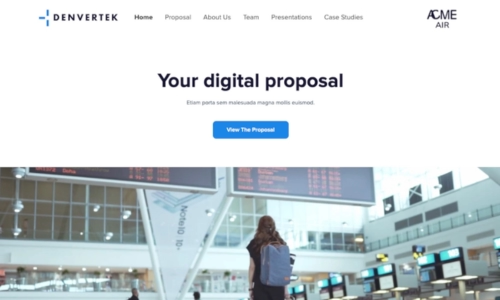
Present as a microsite, not a PDF. A microsite lets you embed videos, demos, and case studies — and track exactly who opens it, which sections they linger on, and when it gets forwarded to the decision-maker. See our guide to presenting a proposal for the format and pacing that works best live.
See how Zoomforth replaces static RFP PDFs
Request a personalized demo and see how enterprise sales teams build trackable, branded RFP microsites in minutes.
Request a demoThe top reasons RFP responses lose — and how to avoid them
Even experienced sales teams fall into the same traps. These three mistakes consistently cost deals, and they are all avoidable with the right process and the right tools.
-
Lack of customization
Using "copy-paste" answers from a generic database without mentioning the buyer's specific goals signals to evaluators that your response is template-driven, not buyer-focused. -
Ignoring the evaluation criteria
Every RFP tells you what the buyer cares about most. Failing to mirror that language and emphasis — especially on high-weight criteria like security or implementation speed — is a critical error. -
Poor formatting and navigation
Sending a 100-page PDF that is impossible to navigate loses deals before the evaluator finishes page ten. If they can't find the information, they can't score it in your favor.
Beyond the PDF: why interactive microsites win more RFP responses
The teams that win aren't just writing better proposals — they're delivering them in a format that is fundamentally more engaging, more trackable, and harder to ignore.
Engagement tracking: Know if the evaluator opened the pricing section, how long they spent on the technical solution, and whether the proposal has been forwarded to the CISO. Follow up with precision, not guesswork.
Dynamic content: Embed videos of your team, interactive demos, and industry-specific case studies. The RFP response becomes a relationship, not just a document in a shared drive.
Security and access control: Revoke access instantly if negotiations change. Password-protect sensitive pricing. Ensure only the right people inside the buyer's organization can reach confidential sections.
Speed at scale: Branded templates mean you can spin up a fully customized, on-brand RFP microsite in a fraction of the time it takes to format a PDF — without waiting for design resources.

With Zoomforth, you can see real-time analytics on what your evaluators are clicking, which pages they are spending the most time on, and whether there is critical information they have not yet reviewed — giving you the intelligence to follow up at exactly the right moment, with exactly the right message.
Purpose-built templates
Start from a branded RFP template — not a blank page. Customize it for each buyer in minutes. Brand compliance is built in, so your team focuses on the content, not the design.
Real-time visitor analytics
See who viewed your proposal, when, and for how long. Track engagement section by section. Know the moment the decision-maker opens your executive summary.
Enterprise-grade security
Password protection, multi-factor authentication, and instant access revocation. Sensitive pricing and confidential data stay visible only to the right people.
The numbers behind the shift to digital RFP responses
Pursuits and bid teams across the world are choosing Zoomforth microsites to present their RFP responses, supplement their bids, and close more deals.
95% of today's B2B buyers prefer shorter, highly visual content formats over long, text-heavy documents. Demand Gen
59% of senior executives agree that if both text and video are available on the same topic, they prefer to watch video. Digital Information World
46% of all B2B researchers and buyers are now millennials who expect fast, mobile-first digital buying experiences. Google
The microsites are a wonderful tool to help us in client pursuits. They allow us the ability to really go deep on our [firm] difference, accolades, client case studies, and videos that we normally would not be able to present in a PowerPoint or RFP response.
Partner, Pursuits Team · Big Four accountancy firm
The use of microsites in the sales process has allowed us to show our clients that we are truly digital, just like our delivery methodology. Microsites allow us to put the depth of thought leadership and experience at the fingertips of our clients — all in an interactive, digital format that is simple to update on the fly.
Senior Manager, Pursuits COE · Big Four accountancy firm
Not only are we closing deals faster. But we're also increasing the amount of closed deals. We probably saw an extra couple hundred thousand dollars in revenue in just the first quarter just by using this platform.
President, Grand Dynamics
Microsite proposals are not a new idea, but Zoomforth allows you to produce them at scale so they are the default, not the exception.
Head of Marketing and Communication · Big Four accountancy firm
RFP response templates and real-world microsite examples
Starting from a blank page is the hardest part of any RFP response. We have curated a gallery of RFP response microsite examples from enterprise sales teams to help you structure your next bid — from the executive summary to the pricing section.
Each example shows how teams are using Zoomforth to deliver branded, navigable, and trackable proposals that stand out in a crowded evaluation process.
See RFP microsite examples
Ready to win your next RFP?
Join enterprise sales teams using Zoomforth to build branded, trackable RFP response microsites that close more deals.
Request a demo today