Skip to content

ABM landing pages: what to include, with examples

Personalized ABM landing page for a named target account shown on a laptop screen

Quick answer: An ABM landing page is a page personalized to a specific target account rather than a broad audience — it names the account, speaks to its situation, and addresses its buying committee. Unlike a standard landing page built for volume, an ABM page is built for relevance to a company you have chosen. For most campaigns, a personalized microsite outperforms a single page because it can hold role-specific content for the whole committee and track who engaged.

A standard landing page is a numbers game: drive traffic, convert a percentage. An account-based marketing landing page plays a different game entirely. You already know exactly which company you want, so the page’s job is not to convert a crowd — it’s to make one specific account feel understood.

This guide covers what an ABM landing page is, how it differs from a regular one, what to include, examples you can adapt, and why microsites increasingly replace single pages for account-based campaigns.

Ready to go digital?
Discover how Zoomforth can help you.

Join 500+ enterprise sales, marketing and HR teams building trackable microsites — no developer needed.

Rated 4.5/5 on G2 · Trusted by Fortune 500 teams

What an ABM landing page is

An ABM landing page is a destination personalized to a specific target account, or a tight cluster of similar accounts, as part of an account-based marketing campaign. Rather than appealing to an anonymous audience, it addresses a named company’s situation directly and gives its buying committee a reason to engage.

The logic follows straight from ABM itself: if you have decided a particular account is worth pursuing, the page that account lands on should reflect that decision. A generic page tells the buyer you are marketing at everyone. A personalized page tells them you understand their specific problem. For the strategy this fits into, see our guide to account-based marketing campaigns.

ABM landing page vs. standard landing page: the key differences

The two look similar and work in opposite ways.

  Standard landing page ABM landing page
Audience Broad, anonymous A named account or tight cluster
Goal Maximize conversion rate Deepen engagement with a known account
Messaging Generic to a segment Personalized to the account’s situation
Success metric Conversion rate, lead volume Account engagement, committee coverage
Content One offer for everyone Role-specific content for the committee

A standard landing page asks “how many of these visitors can I convert?” An ABM page asks “is the account I care about engaging, and is the whole committee involved?”

The measurement difference matters most. Judging an ABM page by aggregate conversion rate misses the point — with a target list of 20 accounts, what you need to know is which accounts and which stakeholders engaged, so sales knows where to focus.

What to include in an ABM landing page

The exact content depends on how personalized the campaign is, but strong ABM pages share a common anatomy:

  1. Account-specific headline. Name the company or its industry and challenge in the first line. The reader should know within seconds that this was built for them.
  2. The problem, in their terms. Restate the account’s situation or initiative — ideally something you learned in research or that the company has stated publicly.
  3. A tailored solution. Connect your offering to that specific problem, not to your feature list.
  4. Relevant proof. Case studies from comparable companies carry more weight than generic logos. Similarity is what makes proof persuasive.
  5. Content for the buying committee. Different stakeholders need different things — a business case for the economic buyer, technical detail for the evaluator, day-to-day value for end users.
  6. A clear, low-friction next step. Usually a meeting or a deeper resource, matched to where the account is in its journey.

The more the page reflects the account’s actual situation, the better it performs. Personalization that stops at inserting a company name is easy for buyers to see through.

ABM landing page examples

Three patterns show how personalization depth scales with the campaign type.

1:1 strategic account. A vendor pursuing a single enterprise prospect builds a page headlined with the account’s own transformation initiative, includes an ROI model using that company’s numbers, and adds a section for each buying-committee role. It reads like it was made for one company, because it was.

1:few industry cluster. A firm targeting a group of hospitals facing the same regulation builds one page personalized to that regulatory challenge and shares it across the cluster. Every account in the group sees content that speaks to its exact pressure — from a single build.

1:many programmatic tier. A company running ads across hundreds of accounts routes each visitor to a version of the page personalized by industry. The personalization is lighter and automated, but it still beats a one-size-fits-all page.

For a gallery of real, personalized account-based pages you can learn from, see ABM landing page examples.

Why microsites outperform single landing pages for ABM

A single landing page has a structural ceiling: it is one page. Enterprise buying committees have three to ten people, each needing different information, and a personalized campaign for a serious account rarely fits above the fold.

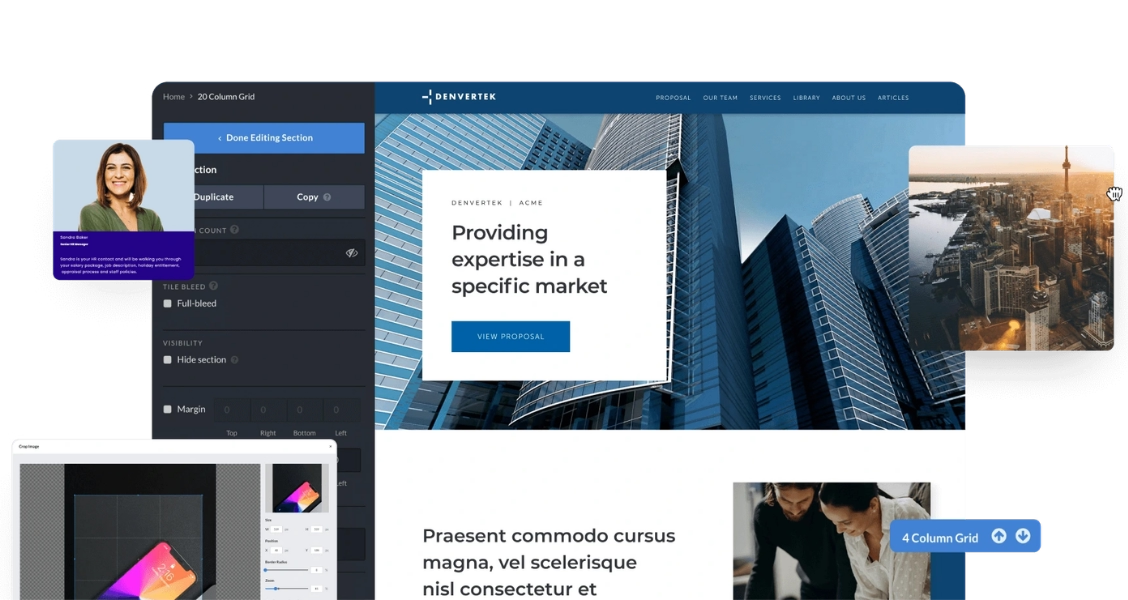
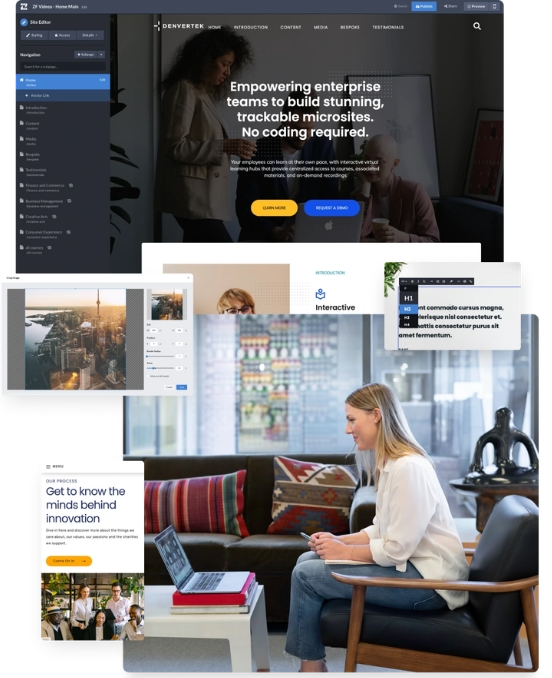
This is why account-based teams increasingly build Zoomforth microsites instead of standalone pages. A microsite is a multi-section, personalized experience the whole committee can navigate — and a marketer can build or clone one per account without code.

  Single ABM landing page Zoomforth microsite
Structure One page Multi-section experience
Committee coverage One message for all roles Role-specific sections
Media Limited Embedded video, demos, documents
Personalization effort Design + dev per account No-code, clone per account or cluster
Analytics Aggregate conversion Per-stakeholder engagement tracking

The analytics are the payoff. When you can see that the economic buyer opened the ROI section twice and the technical evaluator never engaged, sales knows exactly who to follow up with and what to say. That closes the loop between marketing’s page and the deal.

To see how this fits an end-to-end program, explore the account-based marketing use case, or read the benefits of account-based marketing for the strategic case.

Ready to build account-based pages your target accounts actually engage with? Request a demo to see how Zoomforth teams create and track personalized microsites.

Frequently asked questions

What is the difference between an ABM landing page and a regular landing page?

A regular landing page is built for a broad audience and optimized to convert as many visitors as possible. An ABM landing page is personalized to a specific target account or a tight cluster of accounts, addressing that company’s situation by name and speaking to its buying committee. One is built for volume; the other is built for relevance to a known account.

How do you personalize an ABM landing page?

Personalize by naming the target account, reflecting its specific challenge or initiative, referencing relevant case studies from similar companies, and including content for each member of the buying committee. Deeper personalization uses the account’s industry, stated priorities, and stage in the buying journey rather than just swapping a logo or company name.

How do you measure ABM landing page performance?

Measure at the account level, not by raw traffic. Track which target accounts visited, which stakeholders within each account engaged, time spent on key sections, and whether visits led to meetings or pipeline. Per-stakeholder engagement data is more useful for ABM than aggregate conversion rate because it tells sales who to follow up with.

Can a microsite replace an ABM landing page?

Yes, and for most account-based campaigns a microsite is the stronger option. A single landing page is one page; a microsite is a multi-section experience that can hold role-specific content, video, and documents for the whole buying committee, can be personalized per account without code, and provides per-stakeholder analytics a standard landing page cannot.

Frequently asked questions

A regular landing page is built for a broad audience and optimized to convert as many visitors as possible. An ABM landing page is personalized to a specific target account or a tight cluster of accounts, addressing that company's situation by name and speaking to its buying committee. One is built for volume; the other is built for relevance to a known account.

Personalize by naming the target account, reflecting its specific challenge or initiative, referencing relevant case studies from similar companies, and including content for each member of the buying committee. Deeper personalization uses the account's industry, stated priorities, and stage in the buying journey rather than just swapping a logo or company name.

Measure at the account level, not by raw traffic. Track which target accounts visited, which stakeholders within each account engaged, time spent on key sections, and whether visits led to meetings or pipeline. Per-stakeholder engagement data is more useful for ABM than aggregate conversion rate because it tells sales who to follow up with.

Yes, and for most account-based campaigns a microsite is the stronger option. A single landing page is one page; a microsite is a multi-section experience that can hold role-specific content, video, and documents for the whole buying committee, can be personalized per account without code, and provides per-stakeholder analytics a standard landing page cannot.

Stay in the know

Subscribe to our newsletter for design inspiration, tips and best practices. Get event invitations, free resources, and details of upcoming feature releases.

You might also like