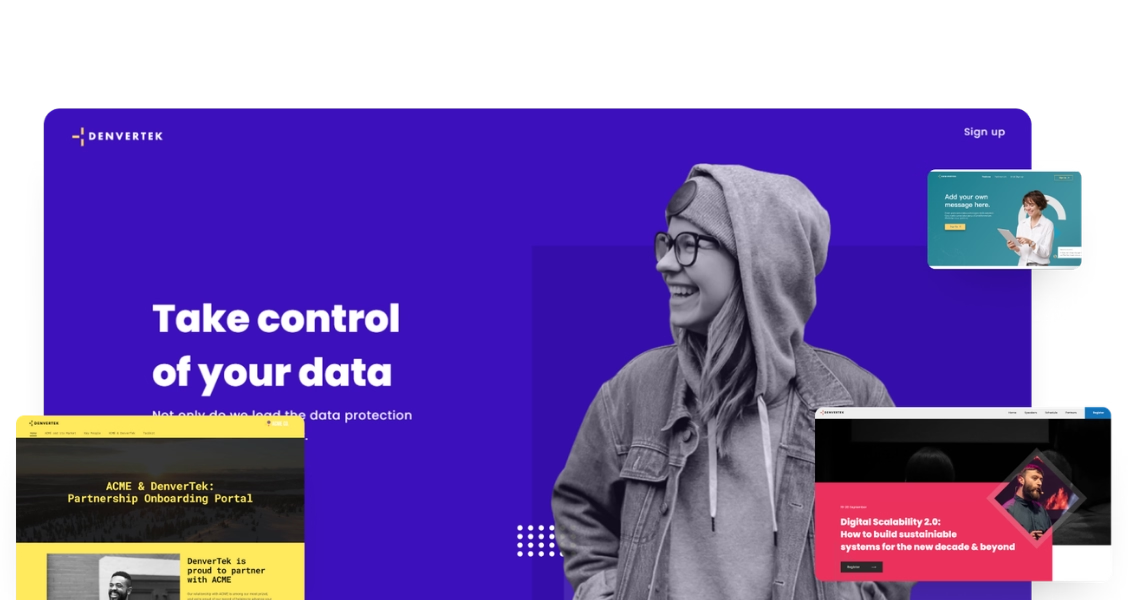
What these ABM landing page examples have in common
Ready to go digital?
Discover how Zoomforth can help you.
Join 500+ enterprise sales, marketing and HR teams building trackable microsites — no developer needed.
Rated 4.76/5 on G2 · Trusted by Fortune 500 teams
Thanks — we've got your request.
Check your inbox — Wendie has sent her calendar link.
While you wait, browse real microsites in our microsite inspiration gallery or learn the basics in the Zoomforth Academy.
The examples below are organised by personalisation level and by industry. Each includes what the team personalised, what they standardised (to keep production scalable), and what drove the conversion outcome.
For the full strategic context — including the four personalisation levels, how to scale ABM pages without a designer, and how to measure account-level performance — see the ABM landing pages guide.

ABM landing page examples by personalisation depth
Industry-level: financial services segment
A B2B technology company created a single ABM landing page for their entire financial services segment — all regulated financial institutions saw the same page. The headline led with compliance and audit trail requirements. The proof section showed logos exclusively from financial services customers. The solution summary emphasised the security certifications and data residency options relevant to regulated industries.
Personalised: Headline, proof section, solution emphasis, compliance certifications highlighted.
Standardised: Visual design, page structure, CTA, brand elements.
Result: The segment page converted at 2.8x the rate of the generic enterprise landing page for the same traffic source.
Account-level: named enterprise target
A sales team built a dedicated ABM landing page for a strategic target account — a global professional services firm they had been pursuing for 18 months. The page opened with a paragraph referencing the firm's publicly announced digital transformation programme. The proof section showed three customers in the same sector with comparable challenges. The solution section was framed around the transformation initiative, not the product features.
Personalised: Opening paragraph, strategic context framing, proof selection, solution narrative.
Standardised: Design system, CTA, core product description, security section.
Result: The account responded within 48 hours of the page being shared by the account team's executive sponsor. The deal entered active pipeline within six weeks.
Role-level: VP of Sales vs. Chief Information Security Officer
One enterprise account, two ABM landing pages. The VP of Sales version led with pipeline acceleration metrics — close rate improvement, proposal-to-meeting conversion, average deal velocity. The CISO version led with security architecture, SOC 2 Type II details, data handling practices, and integration with existing security infrastructure. Both pages described the same product; the emphasis, the proof, and the language were built for different readers.
Personalised: Hero headline and subheading, primary proof metric, first two H2 sections, CTA label.
Standardised: Everything below the fold, visual design, brand elements, FAQ section.
Result: Both stakeholders engaged with their respective pages independently. The sales team had visibility into which sections each stakeholder spent time on before the multi-stakeholder presentation call — which changed the agenda.
Individual-level: named executive
A strategic account management team built a landing page for a specific named executive at their highest-value target — referencing a keynote speech the executive had delivered six months earlier. The opening section quoted a specific statement the executive had made about their digital transformation vision and positioned the product as one of the few solutions designed to execute that vision. The page was shared by the executive's counterpart at the vendor's senior leadership level.
Personalised: Every section above the fold, proof selection, solution framing, the executive sponsor introduction.
Standardised: CTA, supporting documentation, security and compliance section.
Result: The executive opened the page, spent 11 minutes on it, and forwarded it to two colleagues — all visible to the account team before the follow-up call. The account team opened the follow-up call knowing exactly which sections had resonated.
ABM landing page examples by industry
Industry context shapes every element of an effective ABM landing page — the language, the proof, the objections pre-answered, and the conversion CTA. The following examples show how the same product can be positioned very differently for different buying environments.
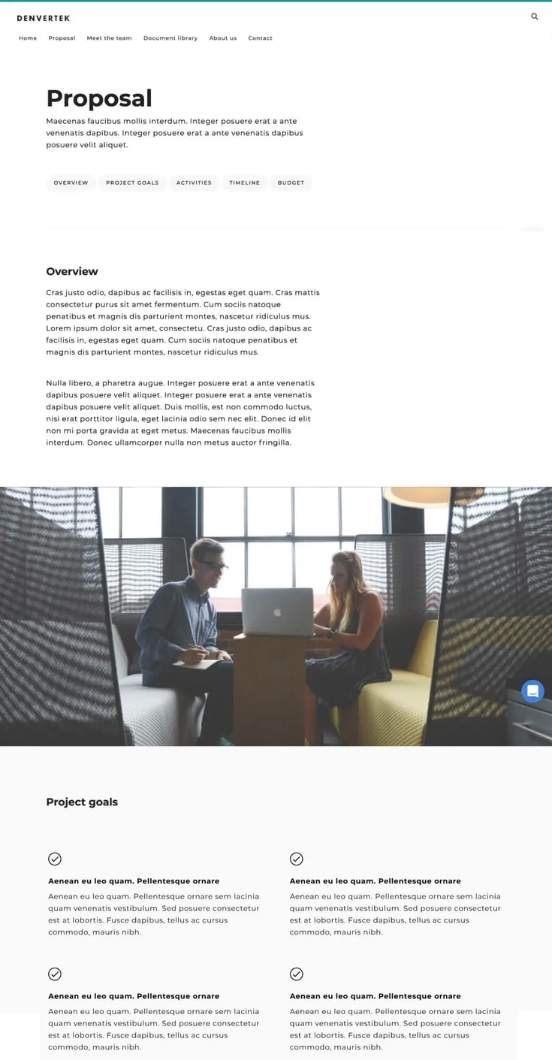
Healthcare: patient outcome framing
A healthcare technology company built ABM pages for health systems where the headline was never about the product — it was always about a patient outcome metric from a comparable institution. "How [Peer Health System] reduced care-gap documentation time by 40%" as an opening positioned the vendor as an outcomes partner, not a software vendor. The product was introduced in section two, after the outcome was established.
What worked: Healthcare buyers are sceptical of vendor claims. Leading with a specific, named peer outcome bypassed that scepticism before the product had even been introduced.
Legal: confidentiality and access control first
For law firm targets, ABM landing pages put access control, privilege protection, and data security in the first section — before any product capability. The sub-headline was consistently some variant of "secure by default, built for regulated client work". The entire information architecture was designed around the assumption that security is the purchase threshold for this buyer — not a feature, but a prerequisite.
What worked: Law firms evaluate every technology vendor through a security and privilege-compliance lens first. A page that addressed this in the opening section cleared the threshold faster and moved the conversation to value sooner.
Manufacturing: operational continuity emphasis
For industrial and manufacturing targets, ABM pages centred on operational continuity — specifically, the risk of proposal and RFP process failures during high-stakes contract bids. The proof section showed manufacturers who had switched from fragmented proposal workflows to a centralised platform and the reduction in bid errors and missed deadlines that resulted.
What worked: Manufacturing buyers are risk-averse by professional culture. An ABM page that framed the product as a risk-reduction tool — not a productivity tool or a creative tool — matched the buyer's mental model and led to higher engagement rates.
9–12. Additional ABM landing page patterns
- Competitive displacement pages — built for accounts known to be using a direct competitor, these pages lead with the specific limitations of the competitor relevant to this account's stage of maturity and the alternatives they would likely evaluate next
- Executive alignment pages — built for C-suite stakeholders who have not been primary contacts in an existing relationship, these pages re-introduce the vendor at the strategic level without assuming the executive has context from operational conversations
- Cross-sell pages — built for existing customers being approached for a new product line, these pages lead with the existing relationship ("you already use X to achieve Y") and frame the new product as the natural next step, not a cold introduction
- Renewal acceleration pages — built for accounts approaching a renewal date, these pages consolidate the value delivered in the existing contract year, present the expansion case, and provide the account champion with a page they can share internally to build the renewal business case
The patterns these examples share
Across all 12 examples, the pages that converted shared a consistent set of characteristics — regardless of industry, personalisation level, or deal stage.

Proof before pitch
Every high-converting ABM page leads with evidence — a customer outcome, a named peer institution, a specific metric — before making a product claim. The reader needs to believe you understand the landscape before they will believe you can solve their problem.

One conversion goal
The highest-converting ABM pages have a single, unambiguous CTA. No secondary offers, no navigation menu pulling the reader away from the page, no competing "download the whitepaper" links. The single goal is almost always a meeting request. Every other element on the page serves that goal.

Specific over generic
The pages that stand out use specific language — the account's publicly stated strategy, a named customer in the same sector, a precise metric from a deployment. Generic claims ("improve efficiency", "reduce costs") are indistinguishable from competitor pages. Specific language signals that the page was not copied from a template.

Short and focused
The highest-converting ABM landing pages are rarely more than four to six sections. The goal is a meeting request, not a comprehensive product education. Lead with the most relevant proof, connect it to the account's priority, show you can solve it, and ask for the meeting. Everything else can wait for the call.
Build ABM landing pages at enterprise scale
Zoomforth is used by enterprise marketing and sales teams to create personalised, trackable ABM pages — from a template, without developers or designers. Request a demo to see how it works.
Request a demo
Frequently asked questions about ABM landing pages
What makes an ABM landing page effective?
An effective ABM landing page demonstrates to the target account that the page was built specifically for them — not repurposed from a generic template. This means a headline that names the account's specific challenge, social proof from their industry peers, and a clear articulation of your solution in the context of the account's known priorities. The page should have a single conversion goal, no competing navigation, and no irrelevant content.
How do you personalise an ABM landing page?
ABM landing pages can be personalised at four levels: industry (all financial services companies see the same page), account (a specific company gets a page referencing their known priorities), role (different stakeholders see different emphasis), and individual (a page built for a specific named person). The right level depends on the account's strategic value and the resources available.
What should an ABM landing page include?
An ABM landing page should include a personalised headline addressing the account's specific challenge, relevant social proof from the same industry or company size, a clear solution summary connecting your product to their known priorities, key differentiators relevant to this account's evaluation criteria, and a single primary CTA — typically a meeting request. The page should have no global navigation.
How do you measure ABM landing page conversion?
ABM landing page conversion is measured by named account visit rate (did the right people at the target accounts open the page), multi-stakeholder engagement (did multiple people from the same account visit), time on section (which parts of the message resonated), return visits (a signal of active consideration), and pipeline influence (did accounts that visited the page convert to opportunities at a higher rate).
Related resources
ABM landing pages guide
The practical guide: personalisation levels, anatomy of a high-converting page, and how to scale ABM pages without a designer for every account.
ABM tools comparison
How the leading ABM platforms compare on personalisation depth, analytics, and enterprise security — with honest assessments of each tool's strengths.
Campaign microsite examples
ABM landing pages are one type of campaign microsite — see product launch, event, and content campaign examples that use the same focused, single-goal structure.
All microsite examples
Browse the full gallery: sales, marketing, recruiting, and onboarding microsites — filter by use case to find designs relevant to your team.