Account-based marketing keeps growing for a simple reason: it maps to how enterprise deals are actually won. Big B2B purchases are made by committees at a small number of companies, so aiming a personalized campaign at those specific companies beats broadcasting to a list and hoping.
This guide covers a quick definition, the seven benefits that drive adoption, how ABM compares with inbound, who gains the most, and how to get started without overbuilding.
Ready to go digital?
Discover how Zoomforth can help you.
Join 500+ enterprise sales, marketing and HR teams building trackable microsites — no developer needed.
Rated 4.76/5 on G2 · Trusted by Fortune 500 teams
Thanks — we've got your request.
We'll be in touch by email to set up your demo.
While you wait, browse real microsites in our microsite inspiration gallery or learn the basics in the Zoomforth Academy.
What account-based marketing is, in one paragraph
Account-based marketing is a B2B strategy that targets a specific, named set of high-value accounts with personalized campaigns, coordinated between sales and marketing. Instead of generating as many leads as possible and qualifying down, ABM picks the accounts worth winning first and concentrates resources on them. The account, not the individual lead, is the unit of work — and that single shift is where every benefit below comes from.
7 proven benefits of account-based marketing
1. Larger average deal sizes
Because ABM targets the accounts you have deliberately identified as high value, the deals it produces are bigger by design. You are not hoping a large account happens to appear in your funnel — you are pursuing them on purpose.
2. Higher return on marketing spend
Concentrating budget on accounts most likely to close and expand produces more revenue per dollar than spreading the same budget across a broad audience. Industry surveys have consistently reported that a majority of teams see higher ROI from ABM than from other marketing activities, which is a large part of why adoption keeps rising.
3. Tighter sales and marketing alignment
ABM only works when both teams share one account list and one definition of success. That forced alignment is a benefit in itself: the two functions stop arguing about lead quality and start collaborating on named accounts, which improves everything downstream.
4. Shorter, more efficient sales cycles
When marketing engages the whole buying committee before sales even calls, deals move faster. Sales spends less time educating cold contacts and more time advancing warm, informed accounts through the process.
5. More relevant buyer experiences
Personalized content aimed at a specific account’s situation feels less like marketing and more like help. Buyers reward that relevance with attention — which is scarce in enterprise B2B.
6. Clearer measurement tied to revenue
ABM metrics — account engagement, buying-committee coverage, pipeline, and revenue — connect directly to business outcomes, unlike vanity metrics such as raw lead counts. Measurement becomes a conversation about revenue, not clicks. Our guide to account-based marketing metrics covers exactly what to track.
7. Less wasted effort
By deciding upfront which accounts fit, teams stop pouring time into prospects that were never going to buy. The discipline of the target list is quietly one of ABM’s biggest efficiency gains.
ABM vs. inbound: which is right for your team?
These two approaches are often framed as rivals. They aren’t — they answer different questions.
| Criteria | Inbound marketing | Account-based marketing |
|---|---|---|
| Direction | Attract a broad audience to you | Reach out to specific chosen accounts |
| Unit of work | The lead | The account |
| Best for | High volume, broad market | High value, defined market |
| Sales cycle fit | Shorter, self-serve | Longer, committee-driven |
| Measured by | Lead volume, traffic | Account engagement, pipeline |
Inbound is efficient at building awareness and capturing demand across a wide market. ABM is what you use when a handful of specific accounts represent most of your potential revenue. The practical answer for most B2B teams is both: inbound fills the top of the funnel and surfaces intent, while ABM concentrates firepower on the accounts that matter most. The two even feed each other — inbound signals can tell you which accounts to target.
Who benefits most from ABM?
ABM is not for everyone, and pretending otherwise is how teams waste a quarter. It delivers the most value when three conditions hold:
- High average contract value. The deal has to be worth the extra effort of research and personalization.
- A defined, finite market. You can name the accounts worth winning — there are hundreds or thousands of them, not millions.
- Committee-driven purchases. Multiple stakeholders decide, so reaching the whole committee matters.
Enterprise software, professional services, and B2B companies selling considered, high-ticket products are the classic fit. If you sell a low-cost, high-volume, transactional product to a vast market, broad demand generation is usually the more efficient choice.
How to get started with ABM without overbuilding
The mistake teams make is treating ABM as a massive technology project before proving it works. Start small.
- Pick a tight first list. Choose 10 to 20 accounts that clearly fit. A focused pilot beats a sprawling launch.
- Align with sales on day one. Agree on the list and on what “engaged” means before spending a dollar.
- Personalize what you can, at the depth the tier deserves. Build a personalized destination for each account or cluster — see our ABM landing pages guide for how to structure one. For how the campaign types and personalization levels work, see our guide to ABM campaigns.
- Measure, learn, and expand. Track account engagement, prove the model on the pilot, then scale to more accounts.
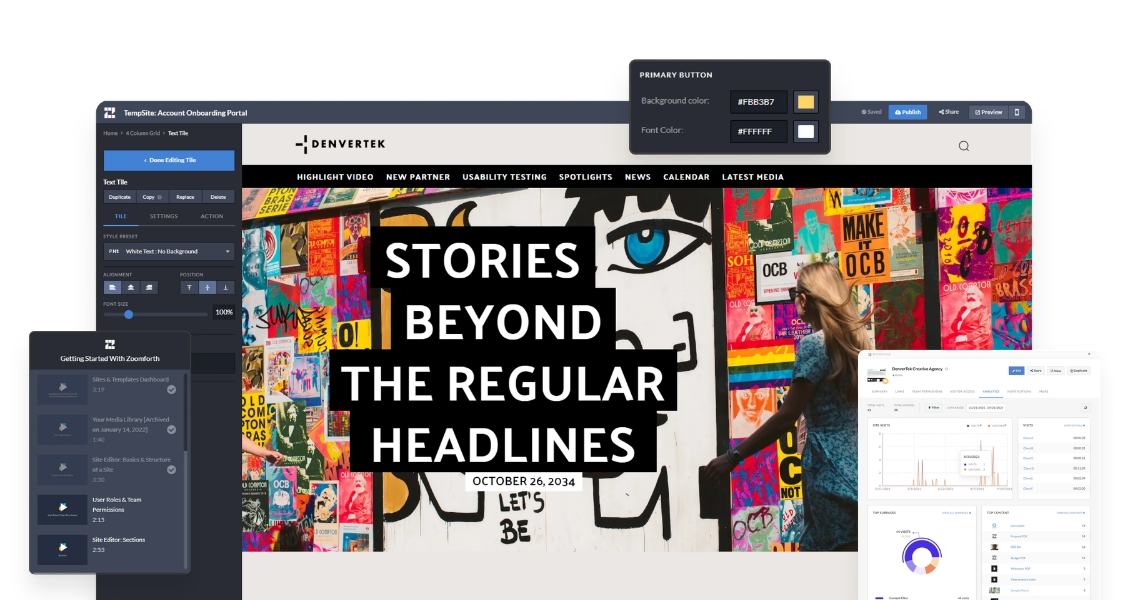
The historical blocker was producing personalized experiences fast enough. With Zoomforth, a marketer can build a branded, personalized microsite for a target account without code and see which stakeholders engaged — turning personalization from a bottleneck into a repeatable step. For the bigger picture, explore the account-based marketing use case or browse real account-based marketing examples.
Ready to concentrate your marketing where it pays off? Request a demo to see how Zoomforth teams run account-based programs.
Frequently asked questions
What are the main benefits of account-based marketing?
The main benefits are larger average deal sizes, higher ROI per dollar spent, tighter sales and marketing alignment, shorter and more efficient sales cycles for target accounts, more relevant buyer experiences, clearer measurement tied to revenue, and reduced waste from pursuing accounts that were never a good fit. ABM concentrates effort where it produces the most return.
Is ABM better than inbound marketing?
Neither is universally better; they solve different problems. Inbound is efficient for generating a high volume of leads across a broad market. ABM is better when you sell high-value deals to a defined set of accounts with buying committees. Most B2B teams run both — inbound to build awareness and capture demand, ABM to win the specific accounts that matter most.
What types of companies benefit most from ABM?
ABM delivers the most value for B2B companies with high average contract values, long sales cycles, and deals decided by a buying committee rather than a single purchaser. It suits teams selling into a finite, identifiable market of target accounts. It is less suited to low-cost, high-volume, transactional products where broad demand generation is more efficient.
What are the challenges of account-based marketing?
The main challenges are the upfront effort of research and personalization, the need for genuine sales and marketing alignment, the longer time to see pipeline compared with volume tactics, and the operational difficulty of producing personalized content at scale. Technology that lets marketers build personalized experiences without engineering support removes much of the last challenge.