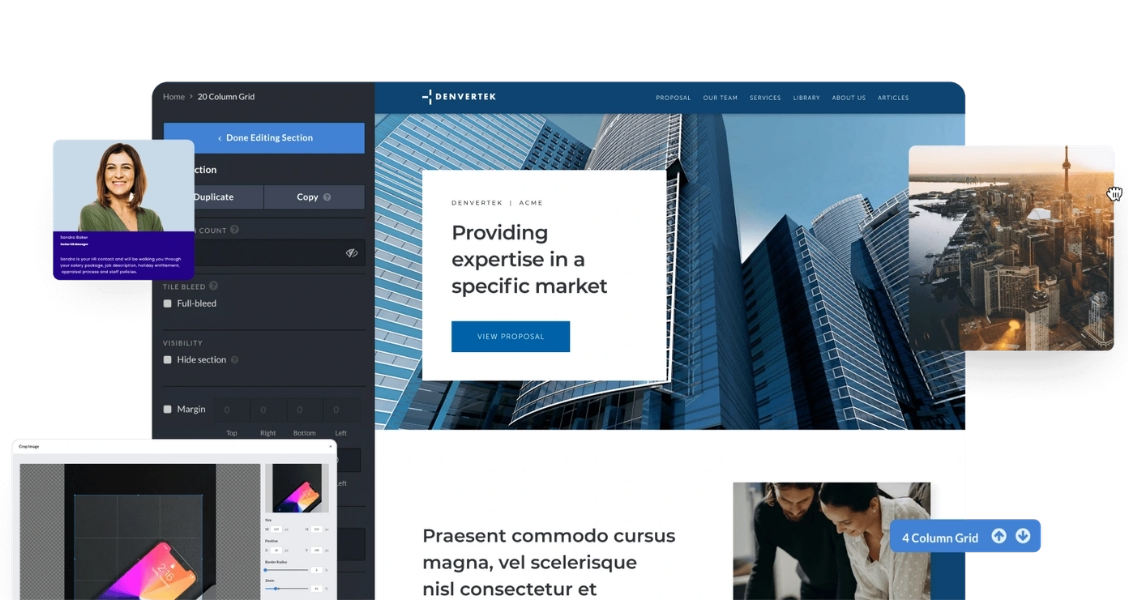
Why marketing teams build standalone microsites for campaigns
Ready to go digital?
Discover how Zoomforth can help you.
Join 500+ enterprise sales, marketing and HR teams building trackable microsites — no developer needed.
Rated 4.76/5 on G2 · Trusted by Fortune 500 teams
Thanks — we've got your request.
Check your inbox — Wendie has sent her calendar link.
While you wait, browse real microsites in our microsite inspiration gallery or learn the basics in the Zoomforth Academy.
A campaign microsite is a dedicated web experience built for a single campaign — separate from the main company website, focused on one goal, and designed to be measured independently. It can be a product launch hub, an event landing, a thought leadership initiative, or an ABM experience for a specific account.
The strategic advantage is focus. A campaign microsite has no competing navigation, no unrelated content, and no conversion paths pulling the visitor in different directions. Every element — headline, imagery, CTA — serves the campaign's single objective.
The operational advantage is speed. Campaign microsites can be launched in days without involving the CMS team or the development queue that typically controls the main website. Marketing can move at campaign speed. When you are ready to build one, see how Zoomforth runs campaign microsites end to end.
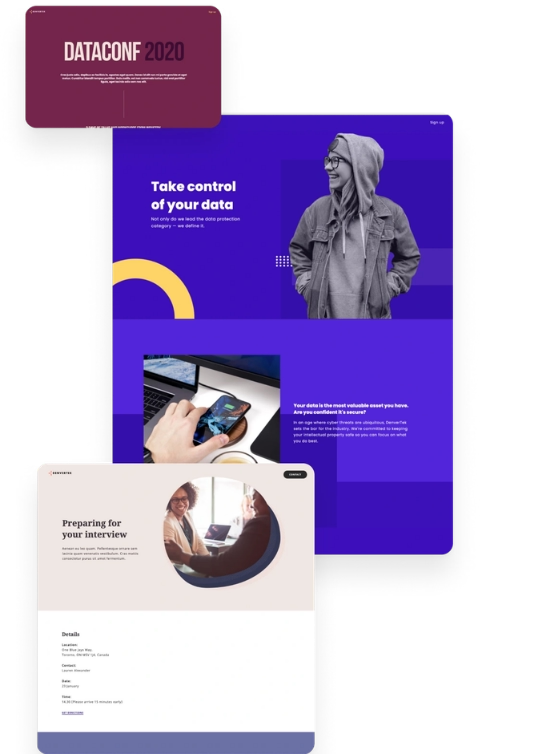
Product launch campaign microsite examples
Product launch microsites give a new product its own dedicated web presence — with the tone, imagery, and conversion architecture that a main website's product page typically cannot accommodate.
1. Enterprise software feature launch — interactive demo hub
A B2B software company launched a major new analytics feature with a standalone microsite rather than a product page update. The microsite included a product overview video, an interactive demo walkthrough, three customer case studies, and a direct "request early access" form. By separating the launch from the main product site, the marketing team could use campaign-specific imagery and messaging without triggering a full website redesign.
Result: The microsite generated 340% more demo requests per visitor than the equivalent product page on the main site, attributed to the focused conversion architecture and absence of competing navigation.
2. Product rebrand launch — brand storytelling microsite
A professional services firm rebranding from a legacy name used a microsite to introduce the new brand narrative before the main website was rebuilt. The microsite combined the brand story, the new visual identity, customer testimonials about the relationship, and a clear "meet the new us" CTA. It let the team control the brand narrative during the transition period without being constrained by the old website's structure.
Result: The microsite became the primary touchpoint for media, partners, and customers during the six-week brand transition — reducing inbound confusion and giving the communications team a single controlled narrative hub.
3. Partnership announcement — co-branded launch hub
Two enterprise technology partners announced an integration with a co-branded microsite that presented the combined value proposition, joint customer stories, and a shared CTA leading to a co-authored solution brief. The microsite allowed both brands to appear equally prominent — something neither company's main website could accommodate without subordinating one brand to the other.
Result: The co-branded hub became the anchor for all joint marketing materials across both companies' channels, providing a consistent reference point that neither partner's site alone could serve.
4. Product category launch — thought leadership + product
A marketing technology company launching into a new product category led with thought leadership rather than a product pitch: a microsite presenting original research on the state of their target market, with the product positioned as the natural solution in the final section. The research was the reason to visit; the product was the destination.
What worked: Leading with credible, original research established authority in the new category before making a product claim. Visitors arrived for the research and left having been introduced to the product.
Event campaign microsite examples
Event microsites consolidate everything a registrant needs — registration, agenda, speaker profiles, logistics, and post-event content — into a single branded experience that can evolve through the event lifecycle.
5. Virtual summit — registration to post-event hub
A B2B marketing team ran a virtual summit for 2,000 registrants entirely through a microsite that evolved through three phases: pre-event (registration, speaker preview, agenda), live event (session links, real-time updates, sponsor content), and post-event (session recordings, summary report, sponsor CTAs). The same URL served all three phases — the team updated the microsite in real time rather than building separate pages for each phase.
What worked: The single persistent URL made promotion simpler (one link to share) and gave attendees a single destination throughout the event lifecycle.
6. Executive roundtable — invitation-only microsite
An enterprise software company ran quarterly executive roundtables for CIOs and CTOs at target accounts. Each roundtable had its own password-protected microsite with the agenda, speaker bios, venue details, and a pre-event reading list. The access control reinforced the exclusive positioning — it was not a public event page, it was a private briefing hub for invited attendees.
What worked: The access-controlled microsite reinforced the exclusivity of the event positioning and gave the host team visibility into which invitees had confirmed attendance by checking the site.
7. Conference presence — pre and post hub
A company attending a major industry conference used a microsite to consolidate their conference presence: pre-show meeting booking, their speaking session materials, booth location, and post-show a library of content shared during conversations at the event. Contacts who scanned a QR code at the booth were directed to the microsite, giving the team a trackable way to continue the conference conversation digitally.
What worked: The QR-to-microsite flow converted in-person interactions into trackable digital relationships. The team could see which contacts returned to the microsite after the event — a strong signal of genuine interest.
Content campaign microsite examples
Content campaign microsites distribute original research, thought leadership reports, and editorial initiatives in a format that is more engaging than a gated PDF download — and that positions the brand as an authority before asking for anything in return.
8. Industry research report — ungated interactive publication
A professional services firm published their annual industry research as an interactive microsite rather than a gated PDF. Visitors could read the full report, share individual sections, and request a conversation with the research team from within the report itself. The interactive format resulted in three times the average session duration compared to PDF downloads from previous years.
What worked: Ungating the research removed the barrier to sharing and significantly extended the report's organic reach — the firm's research was cited in industry media at three times the rate of previous gated editions.
9–15. Additional campaign microsite patterns
Across product, event, and content categories, the highest-performing campaign microsites also include:
- Recruiting campaign hubs — dedicated employer brand microsites for specific roles or office locations, separate from the corporate careers page, with content tailored to the target candidate profile
- ESG and sustainability report launches — interactive annual reports presenting environmental and social data in a format that communicates commitment more effectively than a downloadable PDF
- Partner enablement microsites — password-protected hubs for specific channel partners, with co-branded materials, deal registration forms, and partner-specific training content
- Regional campaign hubs — localised microsites for market-specific campaigns that need different messaging or imagery from the global brand
- Client gifting and end-of-year campaigns — personalised microsites sent to key accounts with a curated message, year-in-review content, and a direct CTA for the next quarter's planning conversation
- Analyst briefing microsites — structured briefing hubs for industry analysts containing company positioning, product roadmap summaries, and customer evidence, shared under NDA via access-controlled links
- Internal campaign launches — company-wide initiative launches (new strategy, new benefits, new tool rollouts) delivered as internal microsites with better engagement rates than email announcements
Recruiting campaign microsite examples
Recruiting campaigns use microsites to communicate employer brand, team culture, and role-specific information in a format that is more compelling than a job board listing — and more trackable than a static careers page.

Role-specific microsites
Rather than sending candidates to a generic careers page, role-specific recruiting microsites tell the story of a specific team, the specific role, and what day one looks like. Candidates who receive a personalised recruiting microsite report feeling that the company has already invested in the relationship before an offer has been made.

Campus recruiting hubs
For university recruiting, campaign microsites are built around specific campus relationships — tailored to each school's student body, the roles being recruited from that campus, and the team members who are alumni. This specificity increases application rates compared to generic graduate recruitment pages.

Executive search microsites
For senior leadership searches, a microsite presents the role, the team, the company's strategy, and the search firm's process in a confidential, access-controlled format. The microsite allows the company to make a detailed case for why a specific executive should consider the role — a richer pitch than a PDF description sent by a recruiter.

Employer brand awareness microsites
Ahead of any specific opening, a microsite can build general employer brand: culture videos, employee testimonials, and a benefits overview in one shareable hub — run alongside always-open job postings rather than as a single campaign push tied to one role.
Build campaign microsites in minutes, not weeks
Zoomforth is used by marketing and recruiting teams to launch branded campaign microsites without a developer or designer. Request a demo to see how fast teams move when the bottleneck is removed.
Request a demo
Frequently asked questions about campaign microsites
What is a campaign microsite?
A campaign microsite is a dedicated, standalone web experience built for a specific marketing campaign — separate from the main company website. It has a focused purpose (a product launch, an event, a content initiative, a promotion), its own URL or subdomain, and a design tailored to the campaign's brand rather than the corporate website's look and feel.
Why do brands use microsites for marketing campaigns?
Brands use campaign microsites because they offer focus (one campaign, one conversion goal, no competing navigation), speed (launched in days rather than weeks of CMS development), and measurability (all traffic and engagement data belongs to the campaign). Campaign microsites also allow for campaign-specific branding that would be disruptive to apply to the main corporate site.
What types of campaigns use microsites?
Campaign microsites are used for product launches, events (registration, agenda, speaker profiles), content initiatives (thought leadership reports, research publications), account-based marketing (personalised landing experiences), partner campaigns (co-branded experiences), and promotions (dedicated landing for time-limited offers).
How do you measure the success of a campaign microsite?
Campaign microsite success is measured differently depending on the campaign goal. For lead generation: form fills, demo requests, and conversion rate. For product launches: time on page, video engagement rate, and click-through to the product page. For event campaigns: registration completions and return visit rate. The advantage of a standalone microsite is that all these metrics are cleanly attributable to the campaign.
Related resources
All microsite examples
Browse the full inspiration gallery: sales, marketing, recruiting, and onboarding microsites — filter by category to find designs relevant to your use case.
Account-based marketing landing page examples
Real ABM landing page designs from B2B marketing teams — industry-segmented pages, named-account builds, and role-specific experiences.
ABM landing pages guide
How to design ABM landing pages that engage target accounts: personalisation tactics, real examples, and tools that scale 1:1 pages without a designer.