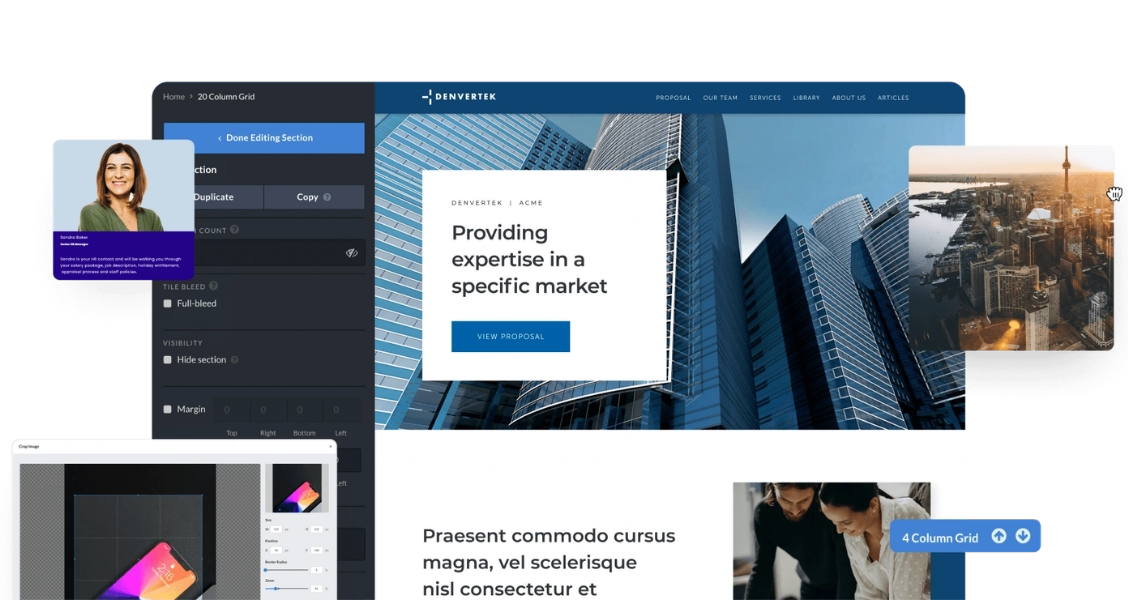
What an ABM landing page is — and how it differs from a standard landing page
Ready to go digital?
Discover how Zoomforth can help you.
Join 500+ enterprise sales, marketing and HR teams building trackable microsites — no developer needed.
Rated 4.76/5 on G2 · Trusted by Fortune 500 teams
Thanks — we've got your request.
Check your inbox — Wendie has sent her calendar link.
While you wait, browse real microsites in our microsite inspiration gallery or learn the basics in the Zoomforth Academy.
An ABM landing page is a dedicated web experience built for a specific target account or segment. Where a standard landing page is designed to convert broad inbound traffic, an ABM landing page is sent directly to named stakeholders at a company you are already pursuing. It speaks their language, reflects their industry, and addresses the challenges that are specific to them — not to a generic buyer persona.
The difference is fundamental. A standard landing page is a billboard on a busy road. An ABM landing page is a personalised letter delivered to the right desk. The conversion logic is different, the content is different, and the measurement is different.
In practice, ABM landing pages sit between a sales proposal and a marketing landing page: they carry the persuasive depth of a proposal but are structured for the moment earlier in the cycle when you are building awareness and interest within a target account.
The four levels of personalisation for ABM landing pages
Not every ABM page needs to be fully bespoke. The right level of personalisation depends on the size of the account, the stage in the buying journey, and the resources available to your team.

Level 1 — industry
The lightest touch: segment your ABM pages by vertical — financial services, healthcare, professional services. The headline, proof points, and use cases shift to reflect the industry, but the page is not account-specific. Best for large segments where 1:1 personalisation is not yet viable.

Level 2 — account
The page is built for one named company, so the headline speaks directly to that company's known challenges. Customer logos and case studies are filtered to the industry peers they already recognise. This is the standard for mid-tier ABM targets, achievable with a solid template system.

Level 3 — role
Multiple versions of a single account page, each one tailored to a different stakeholder — VP of Sales, CMO, Head of IT. The content speaks to that stakeholder's specific priorities and objections. It takes more content investment but is critical for multi-threaded enterprise deals.

Level 4 — person
The deepest personalisation: a page built for one named individual, referencing their public statements, recent company news, or stated priorities. Reserved for the highest-value targets, where a single deal justifies the investment. Typically used in strategic-accounts programmes.
The anatomy of a high-converting ABM landing page
The best ABM landing pages follow a consistent structure, regardless of personalisation depth. Each section earns the reader's attention before asking for the next commitment.
| Section | Purpose | What to include |
|---|---|---|
| Personalised hero | Establish relevance in the first five seconds | Account name (or industry), a headline that names their specific problem, and a clear CTA |
| Problem statement | Show you understand their challenge | 2–3 sentences that describe the pain as the prospect would describe it — not how you would describe your solution |
| Peer proof | Reduce perceived risk | Logos, a short quote, or a brief case study from a company they recognise (same industry or size) |
| Solution summary | Connect your product to their problem | Three to four clear points. Lead with the outcome, then the feature that delivers it |
| Key differentiators | Answer "why you, not someone else?" | Security posture, time to value, integration fit, support model — whatever matters most to this account |
| Single CTA | Convert interest into a meeting | One primary action. Meeting request or demo. No competing links. |
One page, one action
The most common mistake in ABM landing pages is offering too many exit points: navigation menus, multiple CTAs, resource download links. Each additional choice reduces the probability that the reader takes the primary action.
ABM landing pages should have no global navigation (or a stripped version), a single clear CTA repeated no more than twice, and no outbound links that lead the reader away from the page. This is not a website — it is a focused conversation with a specific person at a specific company.

How to scale ABM landing pages without a designer for every account
The biggest operational challenge in ABM is the tension between personalisation (which requires time and effort) and scale (which requires speed and consistency). Here is how leading ABM teams resolve it.

Template-first architecture
Build a master page template with locked brand zones (header, footer, colours, fonts) and clearly defined editable zones (headline, account logo, proof section, CTA). Marketers simply fill in the account-specific fields and never touch the design, so every page stays on-brand and consistent by default.

Modular content blocks
Maintain a library of approved content blocks organised by industry, role, and pain point: financial-services proof points, healthcare case study excerpts, quotes from recognised sales leaders. When building a page, pull the relevant blocks rather than writing from scratch each time.

Tiered investment
Not every account justifies the same effort. Define three tiers: Tier 1 (fully bespoke, built by marketing and sales together), Tier 2 (account-level personalisation from a template), Tier 3 (industry segment, minimal custom work). Reserve your best builds for your highest-value targets.
No-code platform
ABM pages built on a no-code platform mean marketers — not developers — can create, publish, and update pages freely. Sales reps request a new account page and receive it in hours, not days. Brand controls stay enforced at the platform level, so speed never comes at the cost of brand consistency. When you compare the best tools for building ABM landing pages, test this first: can a marketer publish an account page unaided in under an hour?
Build ABM landing pages without a designer
Zoomforth is used by enterprise marketing and sales teams to create personalised, trackable ABM pages — in minutes, from a template, with no code required. See how it works in a 30-minute demo.
Request a demo
ABM landing page examples by personalisation level
The following examples illustrate what effective ABM landing pages look like at each level of personalisation — from industry-segmented pages to fully bespoke 1:1 experiences.
Industry-level: financial services ABM page
A financial services ABM page leads with a headline that speaks to a known industry pain: compliance overhead slowing proposal cycles, or the risk of sharing sensitive deal data over email. The proof section shows logos and a quote from a recognised peer institution. The CTA targets the most common next step for FS buyers — a security review or a compliance conversation — rather than a generic "book a demo".
What makes it work: The prospect immediately recognises that the page was not written for a generic enterprise buyer. The language, the risks cited, and the proof all reflect the financial services buying environment.
Account-level: named-account ABM page
A named-account page for a specific company references that company's recent strategic moves or publicly stated priorities. If they recently announced a sales transformation programme, the page frames the product within that initiative. The proof section shows their direct peers: similar company size, similar industry, similar buying context.
What makes it work: The specificity signals that the account team has done their research. Even if the reader cannot identify exactly what was personalised, the overall impression is that this was written for them — not repurposed from a template.
Role-level: VP of Sales vs. Head of IT
The same account, two pages. The VP of Sales version leads with pipeline velocity and win-rate metrics. The Head of IT version leads with security certifications, data residency, and integration architecture. The core product proposition is the same; the emphasis, proof, and language differ by audience.
What makes it work: Enterprise deals involve multiple stakeholders who care about different things. A single page cannot win all of them. Role-level pages let you run a multi-threaded conversation with the right message for each seat at the table.
See more in the account-based marketing landing page examples gallery.
Measuring ABM landing page performance
Standard web analytics measure page-level traffic. ABM measurement requires per-visitor visibility at the account level. That is also the line between ABM website visitor tracking, which infers which companies visited your public site, and tracking the named people who open a page you sent them. For the tools on each side, see the ABM tools comparison. These are the metrics that matter.
| Metric | What it tells you | Good signal |
|---|---|---|
| Named account visits | Whether the target stakeholders actually opened the page | The right people at the account have visited |
| Multi-stakeholder engagement | Whether the page is being shared internally | Two or more people from the same account have opened it |
| Time on section | Which parts of the message resonated | Long dwell on the proof or differentiator sections |
| Return visits | Whether the account is actively considering | The same stakeholder returns, especially after a sales touchpoint |
| CTA conversion | Whether the page drove the intended next step | Meeting booked or demo requested directly from the page |
Using engagement data in your sales motion
ABM page analytics are most valuable when they feed directly into the sales conversation. If a stakeholder spent six minutes on the security section but only two minutes on the pricing section, the next sales call should open on security — not on price. Per-visitor engagement data lets sales reps walk into every conversation knowing what the buyer cares about, and what they have already absorbed.
This is the feedback loop that separates ABM landing pages from a static PDF or a generic landing page: the page itself generates intelligence about the account that your team can use in real time.
Why microsites outperform single landing pages for ABM
A single landing page has a structural ceiling: it is one page. Enterprise buying committees have three to ten people, each needing different information, and a personalised campaign for a serious account rarely fits above the fold.
This is why account-based teams increasingly build microsites instead of standalone pages. A microsite is a multi-section, personalised experience the whole committee can navigate — and a marketer can build or clone one per account without code.
| Single ABM landing page | Zoomforth microsite | |
|---|---|---|
| Structure | One page | Multi-section experience |
| Committee coverage | One message for all roles | Role-specific sections |
| Media | Limited | Embedded video, demos, documents |
| Personalisation effort | Design and dev per account | No-code, clone per account or cluster |
| Analytics | Aggregate conversion | Per-stakeholder engagement tracking |
The analytics are the payoff. When you can see that the economic buyer opened the ROI section twice and the technical evaluator never engaged, sales knows exactly who to follow up with and what to say. That closes the loop between marketing's page and the deal.
To see how this fits an end-to-end programme, explore the account-based marketing use case, or read the benefits of account-based marketing for the strategic case.
Frequently asked questions about ABM landing pages
What is an ABM landing page?
An ABM landing page is a dedicated web experience built for a specific target account or segment — as opposed to a generic landing page designed for broad inbound traffic. It typically includes personalised messaging, account-specific content (the prospect's logo, industry references, use-case framing), and a single clear call to action relevant to that account's buying journey.
How is an ABM landing page different from a regular landing page?
A regular landing page is designed for a broad audience and optimised for a single conversion action. An ABM landing page is personalised for a named account or segment: it speaks to that account's specific challenges, industry, and role, and is often shared directly with known stakeholders rather than promoted via paid ads. The prospect feels they are reading something built for them, not a generic pitch.
What content should an ABM landing page include?
An effective ABM landing page typically includes a personalised headline and subheading that addresses the account's specific challenge, relevant social proof (industry peers, recognised customers), a clear articulation of the problem you solve for that account type, a summary of your solution and key differentiators, and a single primary CTA — usually a meeting request or demo.
How do you scale ABM landing pages without a designer for every account?
The most scalable approach is a template system: build a master ABM landing page template with clearly defined editable zones and locked brand zones. Marketers fill in the account-specific fields for each new page without touching the design. Platforms like Zoomforth provide this directly — marketers build pages in a browser without code or design tools, and brand controls are enforced at the template level.
How do you measure the performance of an ABM landing page?
Key metrics for ABM landing pages include page visits by named account, time on page per section, scroll depth, return visits, and whether identified stakeholders within the account have engaged. Unlike aggregate web analytics, ABM measurement requires per-visitor visibility: you need to know which individuals at the account opened the page, how long they spent on each section, and whether multiple stakeholders engaged — all signals of account-level intent.
See ABM landing pages built with Zoomforth
Enterprise marketing teams use Zoomforth to build personalised ABM experiences for their most valuable accounts — without design or development resources. Request a demo to see the platform in action.
Request a demoRelated resources
Account-based marketing landing page examples
Browse real ABM landing page designs from B2B marketing teams — industry-segmented pages, named-account builds, and role-specific experiences.
ABM tools comparison
How the leading ABM platforms compare on personalisation depth, analytics, and enterprise security — with honest assessments of each tool's strengths.
Sales microsite platform
See how enterprise sales teams use Zoomforth to build proposals, RFP responses, and account portals that close deals and track engagement.