Sales enablement tools sit between your product knowledge and a signed contract. The right stack helps reps find the right content, deliver it at the right moment, and understand what buyers actually read — without adding five new admin tasks to every deal.
This guide compares 12 tools across the categories that matter most to enterprise B2B sales teams: CRM, interactive content, conversation intelligence, engagement sequencing, and e-signature. For each tool, we cover who it’s built for, what it does well, and where it fits in a modern sales stack.
Ready to go digital?
Discover how Zoomforth can help you.
Join 500+ enterprise sales, marketing and HR teams building trackable microsites — no developer needed.
Rated 4.76/5 on G2 · Trusted by Fortune 500 teams
Thanks — we've got your request.
We'll be in touch by email to set up your demo.
While you wait, browse real microsites in our microsite inspiration gallery or learn the basics in the Zoomforth Academy.
What a sales enablement tool actually does
Sales enablement is the discipline of giving sellers the content, data, and skills to advance buyers through a decision. The tools in this category put that discipline into daily workflow.
A sales enablement tool typically does at least one of the following:
- Organizes content so reps can find the right asset in seconds, not minutes
- Delivers content in a format that gets opened and shared, not ignored
- Tracks engagement so sellers know what the buyer cared about before the next call
- Automates follow-up based on what buyers do, not guesswork
The category spans CRM platforms, proposal builders, analytics tools, and buyer portals. No single tool does all of this well — which is why most enterprise teams run a stack of three to six specialized tools.
Sales enablement platforms vs. sales enablement tools: are they the same thing?
They are used interchangeably in most conversations, and for practical purposes that is fine. But there is a distinction worth holding onto when you are building a stack, because it decides how many vendors you end up with.
A sales enablement tool solves one job. Conversation intelligence is a tool. E-signature is a tool. A proposal builder is a tool. Each does its thing well and integrates with the rest.
A sales enablement platform aims to be the layer several of those jobs run on: content management, training, buyer-facing delivery, and analytics under one login, with one permission model and one set of reporting. Seismic and Highspot describe themselves this way, and so does Salesforce when Sales Cloud is deployed with its enablement modules.
The trade-off is the usual one. A platform reduces the number of integrations you maintain and gives you reporting that spans stages, at the cost of being adequate rather than excellent at some of the individual jobs. Best-of-breed tools do each job better and leave you to join them together — which works while the stack is small and gets expensive in maintenance as it grows.
The practical rule most teams land on: pick a platform for the parts where reporting has to be joined up, and keep tools for the parts where quality decides the outcome. Buyer-facing delivery is usually in the second group, because the proposal is what the customer actually sees. That is the job Zoomforth does as a buyer-facing sales enablement platform, with each deal delivered through a digital sales room.
The list below covers both. Where a product is a platform rather than a single-purpose tool, the category line says so.
How we evaluated these 12 tools
Each tool on this list was assessed against four criteria relevant to enterprise B2B sales:
- Fit for complex deals — multi-stakeholder, long-cycle sales with multiple decision-makers
- Integration with existing workflows — does it connect cleanly to Salesforce, Slack, or what your team already uses?
- Buyer-facing quality — what does the prospect actually experience when they receive your content?
- Insight and analytics — does the tool tell you what happened after you hit send?
The 12 best sales enablement tools for B2B teams
Here’s the full list at a glance, grouped by the job each tool does in a modern sales stack. Detailed breakdowns follow below.
| # | Tool | Category | Best for |
|---|---|---|---|
| 1 | Zoomforth | Interactive proposals & digital sales rooms | Complex B2B deals, buyer portals and proposal delivery |
| 2 | Salesforce Sales Cloud | CRM & pipeline | A single source of truth for 15+ reps |
| 3 | HubSpot Sales Hub | CRM with built-in enablement | Unified marketing-to-sales without Salesforce complexity |
| 4 | Seismic | Sales content management | Large teams with content governance problems |
| 5 | Highspot | Guided selling & content analytics | Connecting content decisions to revenue |
| 6 | Outreach | Sales engagement & sequencing | High-volume SDR/BDR outbound |
| 7 | Gong | Conversation intelligence | Data-driven call coaching |
| 8 | Clari | Revenue intelligence & forecasting | Reliable forecasting for revenue leaders |
| 9 | DocuSign | E-signature | Removing contract-signing friction |
| 10 | LinkedIn Sales Navigator | Prospecting intelligence | Account-based selling to named accounts |
| 11 | Loom | Async video messaging | Briefing multiple stakeholders between calls |
| 12 | Showpad | Shareable content collections | Long cycles with many assets and contacts |
1. Zoomforth — interactive proposals and digital sales rooms
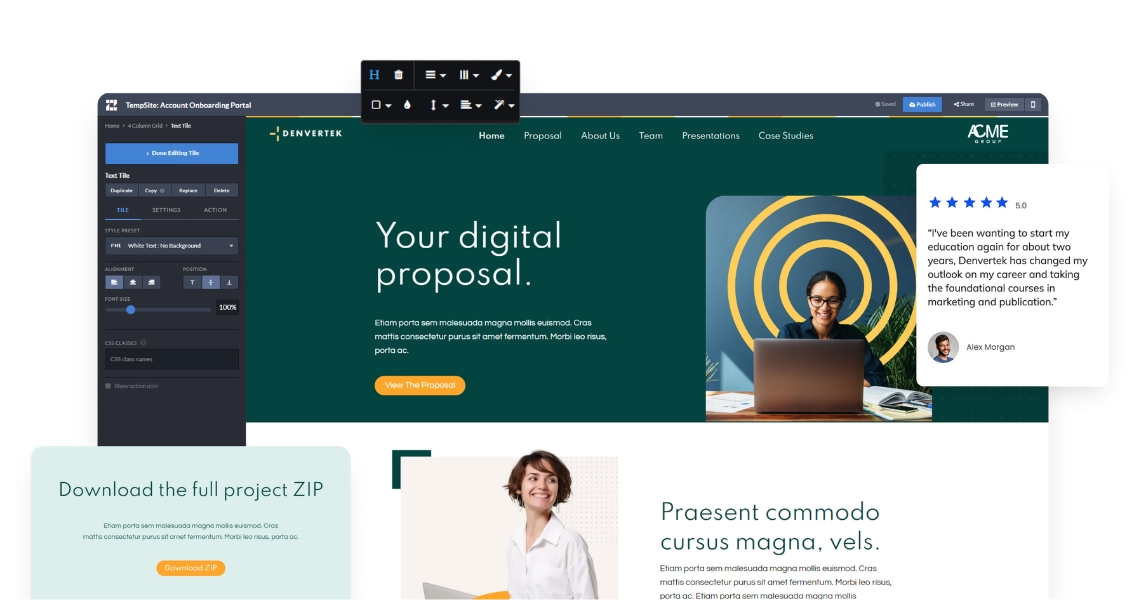
Zoomforth turns proposals, RFP responses, and onboarding materials into branded microsites that buyers can explore at their own pace. Instead of a PDF that gets forwarded and lost, reps send a secure link to a personalized content hub — with embedded video, case studies, pricing summaries, and next steps organized by deal stage.
What sets it apart is per-visitor analytics. Sales teams see exactly which sections the buyer opened, how long they spent on pricing, and whether they shared the link internally — all without asking the prospect. Zoomforth is the only tool on this list purpose-built for the buyer experience side of enterprise deals.
Best for: Teams closing complex B2B deals where the proposal is the differentiator, not just a formality. Replaces static PDF proposals and PowerPoint decks for digital sales rooms, client onboarding hubs, and interactive proposals.
2. Salesforce Sales Cloud — CRM and pipeline management
The enterprise-standard CRM. Salesforce tracks contacts, activities, opportunities, and forecasts. It integrates with nearly every other tool on this list and provides the data foundation that makes the rest of the stack function as a system rather than a collection of disconnected apps.
Best for: Any organization with more than 15 active reps that needs a single source of truth for pipeline and account history.
3. HubSpot Sales Hub — CRM with built-in enablement
HubSpot combines CRM with email tracking, deal pipelines, meeting scheduling, and content sequences. Its tighter integration between marketing content and sales activity makes it attractive for teams where marketing and sales share accountability for pipeline.
Best for: Teams that want a unified marketing-to-sales platform without the complexity of Salesforce plus separate enablement tools.
4. Seismic — sales content management
Seismic centralizes sales content, ensures reps always use the latest version of a deck or one-pager, and tracks which assets move deals forward. Its LiveDocs feature personalizes documents at scale using CRM data, reducing the time reps spend customizing materials manually.
Best for: Large sales organizations where content governance is a real problem — reps sending outdated decks or non-compliant materials to enterprise prospects.
5. Highspot — guided selling and content analytics
Highspot adds a guided selling layer on top of content management. It recommends assets based on deal stage, competitive context, or buyer persona — and reports on which content correlates with won deals, not just which content gets shared most.
Best for: Teams that want to connect content decisions to revenue outcomes, not just asset usage rates.
6. Outreach — sales engagement and sequencing
Outreach automates multi-channel outreach (email, phone, LinkedIn) in structured sequences. It tracks open rates, reply rates, and meeting bookings — and uses that data to help teams optimize sequence timing and messaging at scale.
Best for: SDR and BDR teams running high-volume outbound. Not designed for complex late-stage deal management, where buyer experience tools like Zoomforth take over.
7. Gong — conversation intelligence
Gong records, transcribes, and analyzes sales calls and demos. It surfaces coaching insights (“your top closers spend 43% of the call asking questions”), identifies deal risk signals, and helps managers coach reps on specific conversational moments rather than general impressions.
Best for: Sales organizations that want to improve performance through data-driven coaching rather than intuition and anecdote.
8. Clari — revenue intelligence and forecasting
Clari aggregates signals from CRM activity, email, calls, and deal history to produce accurate revenue forecasts. It helps revenue leaders identify which deals are likely to close versus which are quietly at risk — before it’s too late to intervene.
Best for: Revenue leaders and sales operations teams who need reliable forecasting without manually scrubbing pipeline data week over week.
9. DocuSign — e-signature
DocuSign automates the contract signature process with legally binding e-signatures, routing, and approval workflows. It integrates directly with Salesforce, removing the step of exporting and emailing contracts for signature. Removing that friction alone can shorten close times by days.
Best for: Any B2B sales team still emailing PDF contracts for signature. The ROI is immediate and measurable.
10. LinkedIn Sales Navigator — prospecting intelligence
Sales Navigator gives reps real-time insights on target accounts — decision-maker changes, job postings, shared content, company growth signals. It layers on top of LinkedIn’s network data to improve account-based prospecting without relying on cold databases.
Best for: Account-based selling teams targeting specific named accounts rather than running high-volume cold outreach to a broad market.
11. Loom — async video messaging
Loom lets reps record short videos — a personalized walkthrough of a proposal, a response to a prospect question, a product demo highlight — and send the link instead of scheduling another call. Engagement data (watch time, replay rate) tells you whether the prospect actually watched it.
Best for: Complex enterprise deals where multiple stakeholders need to be brought up to speed between calls. Particularly effective when sent alongside a Zoomforth microsite as part of a proposal presentation package.
12. Showpad — shareable content collections
Showpad focuses on the buyer-facing side of enablement. Reps build shareable content collections for specific buyers, and Showpad tracks how those buyers engage with the materials across a long sales cycle. Analytics reveal which stakeholders are reviewing what, and when.
Best for: Complex enterprise deals where multiple assets are shared with multiple contacts over weeks or months, and where understanding buyer behavior is as important as creating the right content.
How to build your sales enablement stack
Not every tool belongs in every stack. Here’s a practical framework for building one:
Start with your CRM. Salesforce or HubSpot anchors everything else. Every other tool in your stack should integrate here.
Add conversation intelligence early. Gong or a comparable platform helps you understand what’s actually happening in buyer conversations before you invest in optimizing what you send.
Then fix what buyers receive. This is where Zoomforth enters. The question is whether your problem is internal (reps can’t find content) or external (buyers don’t engage with what they receive). Zoomforth solves the external problem — what the buyer opens, explores, and shares determines whether the deal advances.
Layer in sequencing and e-signature. Outreach for early-stage prospecting, DocuSign for late-stage close. These are process tools, not relationship tools.
Avoid duplication. Gong and Clari overlap significantly. Seismic and Showpad serve similar functions. Choose one per category and integrate it properly before adding the next tool.
Why the buyer experience is the gap most stacks leave open
Most sales enablement tools solve an internal problem: reps can’t find content, managers can’t forecast, leaders can’t coach. Fewer tools address what the buyer actually experiences after the rep hits send.
A branded, trackable microsite proposal signals professionalism before the first meeting. It gives buyers a curated space to share internally with stakeholders the rep may never meet. And it returns engagement data that makes every follow-up conversation more precise.
If your team is closing enterprise deals with PDF attachments and PowerPoint decks, that’s the gap your stack is missing. See how 10 buyer enablement tools compare if that buyer-facing gap is the one you’re solving for next.
Ready to see how it works? Request a demo.
For the questions behind the tooling — who should own sales enablement, what its pillars are, and how it differs from revenue enablement — see our guide to what sales enablement is and the sales enablement strategy guide.
Frequently asked questions
What are sales enablement tools?
Sales enablement tools are software platforms that help sales teams access, create, and deliver the right content to buyers at the right stage of the sales cycle. They include CRM systems, proposal builders, content management platforms, and buyer engagement analytics.
What is the difference between a CRM and sales enablement?
A CRM tracks relationships and pipeline data — who the contacts are, what stage each deal is at, what happened last. Sales enablement covers the content and experiences salespeople deliver to prospects: proposals, presentations, microsites, and training materials. Put simply, the CRM records the deal and sales enablement moves it. They work together and neither replaces the other, which is why CRM integration is one of the first things to check on any enablement tool.
What is the best sales enablement platform?
There is no single best platform, because the category covers several different jobs. Seismic and Highspot are the established choices for large teams that need content management and training under one system. Salesforce and HubSpot are the answer when the priority is CRM-native enablement. Zoomforth is the strongest fit for the buyer-facing part — turning proposals, RFP responses and onboarding into branded, trackable experiences. Decide which job is costing you deals first, then pick for that; a platform chosen on feature count rather than on a specific gap tends to go unused.
How do I choose between a sales enablement platform and best-of-breed tools?
Pick a platform for the parts where reporting has to be joined up across stages, and keep single-purpose tools for the parts where quality decides the outcome. A platform reduces the number of integrations you maintain and gives you reporting that spans content, training and delivery, at the cost of being adequate rather than excellent at some individual jobs. Best-of-breed tools do each job better and leave you to connect them, which works while the stack is small and gets expensive to maintain as it grows. Buyer-facing delivery usually belongs in the best-of-breed group, because the proposal is what the customer actually sees.
What tool is best for creating interactive sales proposals?
Zoomforth is purpose-built for creating interactive sales proposals and microsites. It allows teams to build branded, trackable digital experiences without writing code, replacing static PDFs with engaging buyer portals.
How many sales enablement tools does a team need?
Most B2B sales teams use between three and six specialized tools. A typical stack includes a CRM, a content delivery or proposal tool, a conversation intelligence platform, and an e-signature solution. The right number depends on deal complexity and team size.