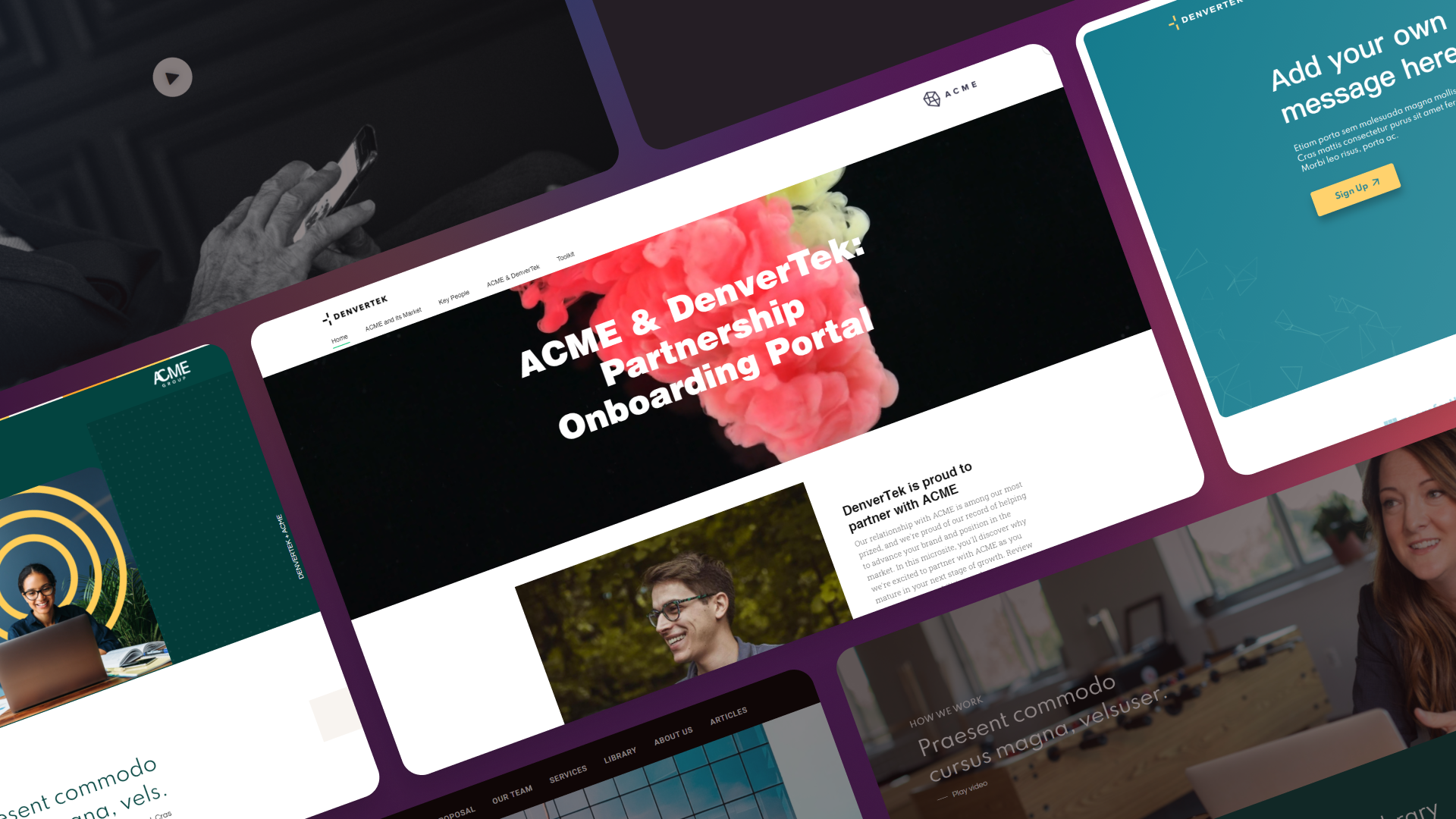
Franchise organizations run into the same problem from two directions. Marketing needs every location to look like part of the same brand. Local teams need pages that actually reflect their address, hours, staff, and promotions. A single corporate website cannot do both, and a website-per-location built ad hoc by local teams or outside agencies drifts from the brand within a few months.
A franchise microsite solves this by separating what stays fixed — logo, color palette, required legal language, core messaging — from what changes per location, so a network of 50 or 500 sites can each have their own page without 50 or 500 separate design decisions.
Ready to go digital?
Discover how Zoomforth can help you.
Join 500+ enterprise sales, marketing and HR teams building trackable microsites — no developer needed.
Rated 4.5/5 on G2 · Trusted by Fortune 500 teams
Thanks — we've got your request.
Our team will follow up shortly. If you'd rather pick a time yourself, grab a slot below.
Why a single corporate site and one-off local pages both fail franchises
A corporate website is built to represent the brand as a whole. It cannot show a specific location’s address, current promotions, or local staff without either bloating into an unmanageable directory or forcing every visitor through a location-picker before they see anything relevant.
The usual workaround — letting each franchisee or local agency build their own page — solves the local-relevance problem and creates a brand-consistency problem instead. Fonts drift, logos get stretched or recolored, legal disclaimers get dropped, and messaging starts contradicting corporate positioning. This is the same tension behind the “maintaining brand consistency” and “governance and approvals” concerns that consistently rank among the top challenges enterprise teams report when managing content at scale across many stakeholders.
Two distinct use cases, two different microsites
“Franchise microsite” covers two purposes that share a platform but not a structure.
Franchise development microsites target prospective franchisees, not customers. Their job is to sell the opportunity: investment range and fee structure, territory availability, training and support model, current franchisee testimonials, and a clear inquiry or application path. This is close in structure to a recruitment microsite — the audience is deciding whether to buy in, not whether to buy a product.
Local location microsites target customers of one specific site. Their job is local relevance: address and hours, directions, local team or staff photos, location-specific promotions, and reviews or proof from that market. These need to update fast and often, on a schedule the corporate marketing team cannot own for every location individually.
Treating both as the same page produces a page that does neither well — too sales-heavy for a customer looking for store hours, too transactional for a prospective franchisee evaluating a multi-year investment.
What stays locked, and what a location or franchisee should control
The core of running franchise microsites at scale is deciding, once, what belongs in each bucket.
- Locked by the franchisor: logo, color palette, typography, required legal and compliance language, core brand messaging, and the overall page structure.
- Editable per location or franchisee: address, hours, phone number and contact form, staff or team photos, local promotions or offers, and location-specific testimonials.
Getting this split right up front is what lets a franchisor open a new location’s page in hours instead of commissioning a new design, while still guaranteeing that every one of 50 or 500 pages passes a brand review without individual sign-off.
Content blocks for a franchise development microsite
- The opportunity, in plain terms. Investment range, ongoing fees, and what is included, presented clearly rather than buried in a PDF a prospect has to request.
- Support and training model. What corporate provides before and after opening — this is usually the deciding factor once the financials clear a prospect’s bar.
- Territory availability. A clear answer to whether the market a prospect is asking about is open, without making them submit a form to find out.
- Current franchisee proof. Short testimonials or a day-in-the-life look from existing franchisees, which carries more weight with prospects than corporate copy.
- A single clear next step. One inquiry path, not a menu of contact options that splits intent.
Content blocks for a local location microsite
- Address, hours, and directions, above the fold, with nothing between the visitor and this information.
- Local team, real photos of the people a customer will actually meet, not corporate stock imagery.
- Local promotions, editable by the location without a design request each time an offer changes.
- Local proof, reviews or testimonials specific to that market rather than brand-wide claims.
Measuring a franchise microsite program
A single conversion number across every location tells a franchisor little. Two comparisons matter more:
Location-to-location consistency. Are all pages passing brand review, or are a handful of locations quietly drifting because a franchisee edited outside their allowed fields? This is a governance metric as much as a marketing one.
Time to launch a new page. How long does it take from a new location signing or a new franchisee being approved to their page going live? A governed template should cut this from weeks of custom design work to hours of filling in the editable fields — the entire point of separating locked brand elements from local content in the first place.
For the broader case on why a governed template beats a one-off build for any recurring page type, see this microsite guide. And because many franchise programs run seasonal or campaign-driven promotions across locations at once, the same governance logic extends to a campaign microsite built once and localized per site.
Ready to give every location or franchisee a consistent, on-brand page without a design request each time? Request a demo.
Frequently asked questions
What is a franchise microsite?
A franchise microsite is a dedicated, branded page built for a single franchise location, a local market, or a franchise development campaign — built from the same governed template so every version stays on-brand without a custom build per site.
How is a franchise microsite different from a local landing page?
A local landing page is usually a one-off built by a franchisee or an agency, with brand consistency depending entirely on who builds it. A franchise microsite comes from a governed template the franchisor controls, so local details change but logo, colors, legal disclaimers, and messaging stay locked.
Can franchisees edit their own microsite content?
Yes, if the platform supports it — franchisees can typically update local details like address, hours, staff photos, and promotions within fields the franchisor defines, without being able to touch brand elements like the logo, color palette, or required legal copy.
What's the difference between a franchise development microsite and a local location microsite?
A franchise development microsite targets prospective franchisees and is built to sell the opportunity — investment range, support model, territory availability. A local location microsite targets customers of a specific site and focuses on address, hours, local promotions, and staff.