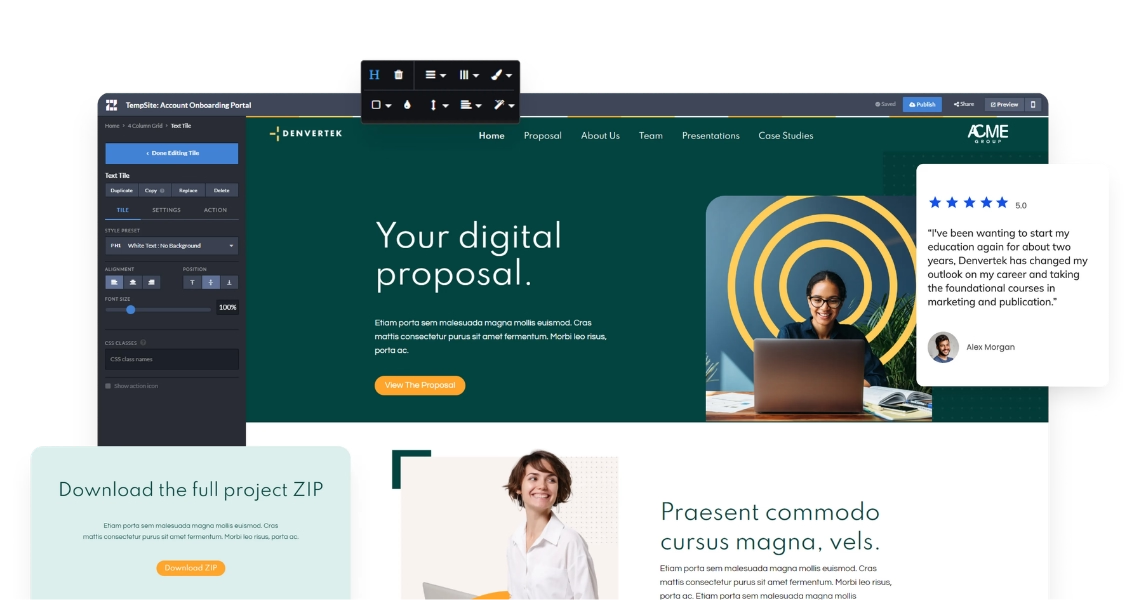
A digital sales room and a sales enablement platform get folded into the same conversation, but they solve different problems. A digital sales room is built for one deal: a branded microsite a buyer and seller share while that opportunity is open. A sales enablement platform is built for every deal a rep works at once, under one login. Seismic and Highspot own that second definition today, and this comparison covers where the two categories actually split, plus where Zoomforth fits.
Ready to go digital?
Discover how Zoomforth can help you.
Join 500+ enterprise sales, marketing and HR teams building trackable microsites — no developer needed.
Rated 4.76/5 on G2 · Trusted by Fortune 500 teams
Thanks — we've got your request.
We'll be in touch by email to set up your demo.
While you wait, browse real microsites in our microsite inspiration gallery or learn the basics in the Zoomforth Academy.
What a digital sales room actually is
A digital sales room is a private, branded microsite built around one buyer and one deal. The proposal, pricing, case studies, and next steps live behind a single link that both sides return to as the deal moves, and the seller can see who opened which section and when. The buyer gets a self-serve space instead of a chain of email attachments; the seller gets engagement data instead of guesswork. Zoomforth builds this kind of enterprise digital sales room for competitive, multi-stakeholder deals.
For the full definition, how digital sales rooms work step by step, and what to include, see our guide to what a digital sales room is. This post assumes that context and focuses on the one distinction that causes the most confusion in procurement conversations: how a digital sales room differs from a sales enablement platform.
What a sales enablement platform actually is
A sales enablement platform solves a different problem: giving reps, across every deal they’re working, one place to find the right content, follow a guided-selling playbook, and get trained and coached. It isn’t built around a single opportunity. It’s built around the whole team’s ongoing work, and it usually combines four things under one login: a content library so reps can find the right asset in seconds, guided-selling recommendations tied to deal stage or buyer persona, training and coaching tools, and analytics that connect content usage to won deals.
Seismic and Highspot are the two platforms most associated with this category. Seismic centralizes content with governance and versioning for large distributed teams; Highspot adds a guided-selling layer that reports on which content correlates with revenue, not just which content gets opened. Both describe themselves as a platform rather than a single-purpose tool for a reason: the pitch is fewer vendors to manage and reporting that spans content, training, and delivery under one roof, at the cost of being adequate rather than excellent at any one of those jobs individually. We cover twelve tools across this space, sales enablement platforms included, in our sales enablement tools comparison, so this post won’t re-run that tool-by-tool breakdown. Zoomforth approaches the category from the other side, as a buyer-facing sales enablement platform: it covers the content that leaves the rep’s hands and reaches the buying committee.
The core difference: deal-specific vs. team-wide
The distinction holds regardless of which vendors are on the shortlist. A digital sales room is scoped to one opportunity; a sales enablement platform is scoped to the team.
| Digital sales room | Sales enablement platform | |
|---|---|---|
| Built around | One deal | Every deal, across the whole team |
| Primary audience | The buyer and the buying committee | Reps, managers, and marketing |
| Lifespan | Lives for the length of one opportunity | Ongoing, spans every deal a rep works |
| Core job | Present the deal and show engagement analytics | Store and govern content; train and recommend |
| Analytics | Per-stakeholder engagement on one room | Asset usage and content performance, org-wide |
| Typical vendors | Zoomforth, Trumpet, GetAccept | Seismic, Highspot, Showpad |
Where this gets confusing in practice: Seismic and Highspot each ship a native digital-sales-room feature as part of the broader platform, so a rep on either tool can build a deal-specific room without leaving it. That doesn’t collapse the two categories into one thing. The room is still a single feature attached to a rep-facing system built for a different job, which is why the two terms end up used interchangeably in a lot of vendor conversations even though they answer different questions.
That matters for how you evaluate the fit. If the actual gap is “reps can’t find the right content” or “we have no visibility into what training moves deals,” a digital sales room doesn’t touch that problem. If the gap is “the proposal itself doesn’t reflect the effort we put into the deal,” a sales enablement platform’s native room feature and a purpose-built digital sales room aren’t automatically the same answer, either — which is what the next section covers.
It also tends to explain who owns the budget on each side. A sales enablement platform is usually a sales-ops or revenue-operations purchase, justified by content governance and training metrics across the whole team. A digital sales room is more often owned by a sales or marketing leader focused on how individual deals present to buyers, and it’s evaluated on deal-level outcomes rather than team-wide content usage. Knowing which budget line a request sits under is a quick way to tell which category actually needs solving.
Are digital sales rooms built into a platform like Seismic secure?
Buyers evaluating this category, reasonably, ask about security before anything else. A digital sales room can carry pricing, contract terms, and other information neither side wants exposed outside the deal.
Seismic is SOC 2 Type II, ISO 27001, and ISO 27701 certified, encrypts data in transit and at rest, and holds EU-U.S. Data Privacy Framework certification — a genuinely solid enterprise security program, and one buyers can verify directly rather than take on faith. Highspot publishes comparable certifications for its own platform. Neither vendor’s security posture is the weak point in this comparison, and it would be inaccurate to suggest otherwise.
The more useful question during a security review isn’t whether the vendor overall is certified — for either Seismic or Highspot, it is. It’s how granular the controls are on the room itself. A native digital-sales-room feature built inside a broader content platform sometimes inherits that platform’s account-level permission model rather than giving each individual room its own password, domain restriction, or expiry set independently of the rest of the account. Ask specifically whether one room can be locked down on its own terms, not just whether the parent platform holds the right certifications.
That question is worth asking of any vendor’s digital sales room feature, purpose-built or not. Zoomforth’s own security program covers similar ground — SOC 2 Type II, audited annually, SAML single sign-on, encryption in transit and at rest, and GDPR and CCPA compliance — and it applies per room by design, since a deal-specific microsite is the only thing the platform builds. See our enterprise microsite security page for the full list of controls, and verify the specifics directly with any vendor before a deal-sensitive room goes live.
Where Zoomforth fits
Zoomforth sits in the digital sales room category, not the sales enablement platform one, and it’s worth being direct about that boundary. It doesn’t manage a content library, run guided selling, or handle rep training or coaching — if that’s the gap, Seismic or Highspot is the right conversation to have, not Zoomforth.
What Zoomforth does is build the deal-specific piece: a branded, no-code microsite for the proposal, deal room, or client portal, with per-visitor analytics on which stakeholder viewed which section and for how long. Because it’s the only thing the platform is built to do, the design and access controls go deeper per room than a room feature attached to a broader content system typically supports. Teams comparing patterns for their own deal can see 10 digital sales room patterns that close deals, or compare a dedicated deal-tracking tool directly in our Dock alternatives guide.
Some teams run Zoomforth for the buyer-facing room and keep Seismic or Highspot for the internal content and training layer — the two aren’t competing for the same job, so running both isn’t redundant. Others, mid-way through re-evaluating a sales enablement platform for unrelated reasons, use the moment to separate the two problems for the first time. If a pending renewal is the trigger, see our breakdown of what changed after the Highspot and Seismic merger.
How to decide which one solves your problem
Three questions narrow this faster than reading a feature list.
Is the gap rep-facing or buyer-facing? If reps can’t find the right asset, don’t follow a consistent pitch, or need coaching to improve close rates, that’s a sales enablement platform problem. If the proposal or deal room itself doesn’t hold up once it reaches the buyer, that’s a digital sales room problem, and a content platform’s native room feature may not close it.
Do you actually need one, or both? Most enterprise sales organizations eventually run both — a sales enablement platform for the team’s ongoing content and training, and a digital sales room for the buyer-facing artifact each deal produces. Neither replaces the other; they sit on opposite sides of the same handoff, one internal and one external.
Are you evaluating because of a specific event? A pending Seismic or Highspot renewal, a merger, or a security review are each reasons to separate the two problems explicitly rather than treat “sales enablement” as a single line item. Use the security questions above if a review is the trigger, or the sales enablement tools comparison if the platform side is what’s actually under evaluation.
None of this makes the terms interchangeable, even though vendors on both sides use them loosely. A sales enablement platform and a digital sales room answer different questions, and the fastest way to a wasted evaluation is picking a vendor before deciding which question your team is actually asking.
Ready to see the buyer-facing side of your next deal in a Zoomforth room? See Zoomforth in action or request a demo.
Frequently asked questions
What is a sales enablement platform?
A sales enablement platform is software that helps sales teams manage content, training, and guided selling across every deal a rep works, not just one. It typically combines a content library, playbooks, coaching tools, and analytics on which assets get used and which correlate with won deals. Seismic and Highspot are the two platforms most often described this way.
What is the difference between a digital sales room and a sales enablement platform?
A digital sales room is a branded microsite built for one specific deal; the buyer and seller both use it, and it exists for the length of that opportunity. A sales enablement platform is an internal system reps and managers use across every deal: a content library, training modules, and guided-selling recommendations. Put simply, a digital sales room is buyer-facing and deal-specific, while a sales enablement platform is rep-facing and ongoing.
Are Seismic digital sales rooms secure?
Seismic is SOC 2 Type II, ISO 27001, and ISO 27701 certified, encrypts data in transit and at rest, and holds EU-U.S. Data Privacy Framework certification, which is a genuinely solid enterprise security program. The more specific question to ask during a security review is not whether the vendor overall is certified, but how granular the access controls are on the digital sales room feature itself: whether each room supports its own password, domain restriction, or expiry independent of the account's broader permission model. That question applies to any vendor's digital sales room feature, not just Seismic's.
Is Zoomforth a sales enablement platform?
No. Zoomforth doesn't manage a content library, run guided selling, or train reps, which is the core job of a sales enablement platform like Seismic or Highspot. Zoomforth is a digital sales room platform: it builds the branded, deal-specific microsite a rep sends to a buyer, with per-visitor analytics on what that buyer engaged with. Many teams run Zoomforth alongside a sales enablement platform, using each for the job it's built for.