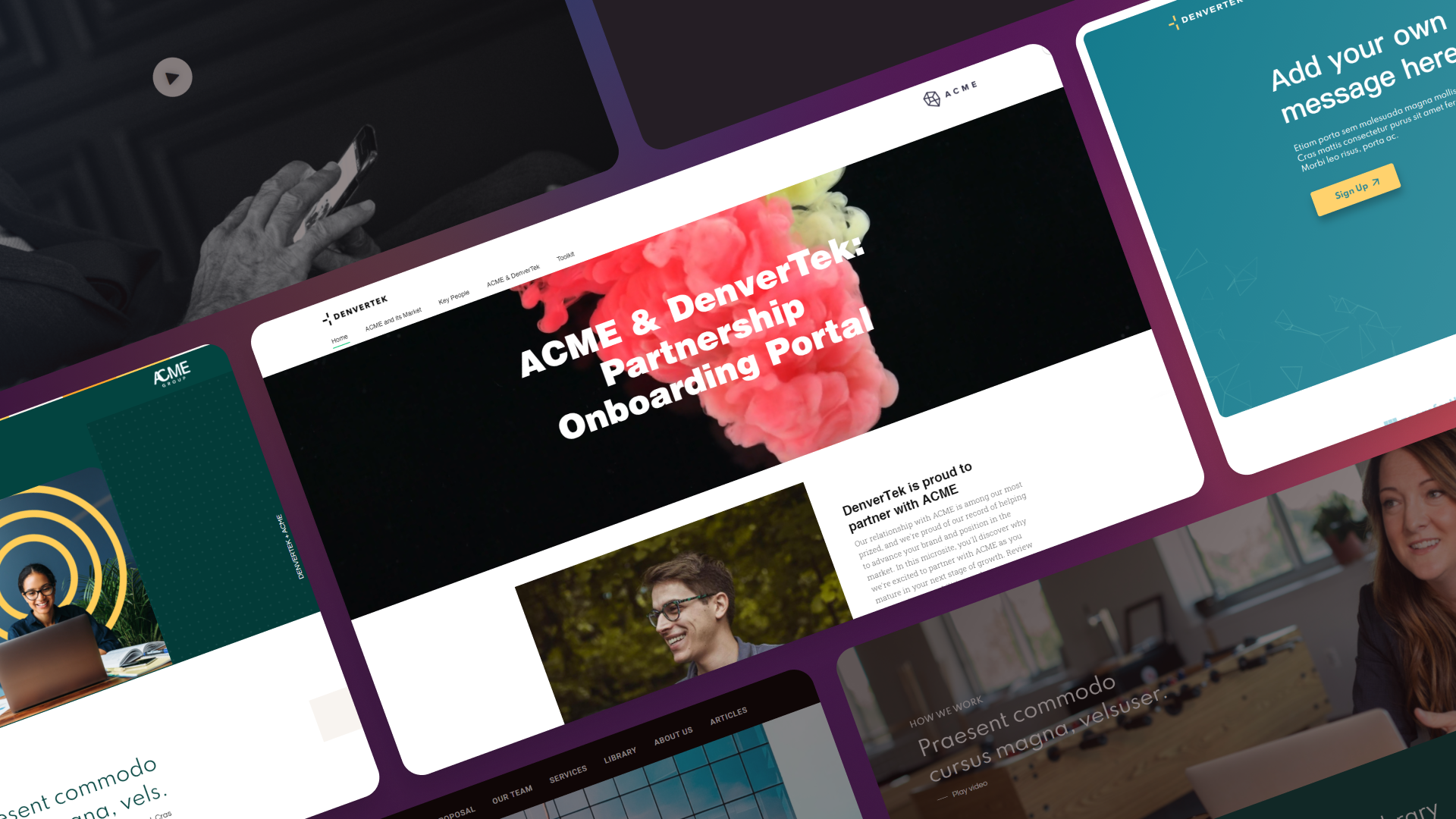
Type “best microsite builder” into a search engine and the results skew toward general-purpose website and landing page tools — useful for a personal project, not for a sales team that needs to ship a branded, trackable, secure microsite for a Fortune 500 prospect by Friday.
This guide splits the category honestly into two groups: platforms built for enterprise teams (sales, marketing, HR, recruiting) that need brand governance, security, and per-visitor analytics — and tools built for individual creators and small storefronts, which solve a different problem entirely.
Ready to go digital?
Discover how Zoomforth can help you.
Join 500+ enterprise sales, marketing and HR teams building trackable microsites — no developer needed.
Rated 4.5/5 on G2 · Trusted by Fortune 500 teams
Thanks — we've got your request.
Our team will follow up shortly. If you'd rather pick a time yourself, grab a slot below.
Enterprise microsite builders vs. creator tools, at a glance
| Platform | Built for | Per-visitor analytics | Enterprise security | Starting price |
|---|---|---|---|---|
| Zoomforth | Enterprise sales, marketing, HR, recruiting | Yes, every user | SOC 2 Type II, SSO/SAML, MFA | Custom (14-day free trial) |
| Ceros | Design-led marketing teams | Limited by plan | Varies by plan | Custom, enterprise-tier pricing |
| Foleon | B2B content marketing, lead gen | Limited by plan | Varies by plan | Custom |
| Qwilr | Individual sales proposals | Gated to higher plans | Limited | From ~$35/user/mo |
| Turtl | Long-form brand storytelling | Varies by plan | Varies by plan | Custom |
| Tiled | Interactive microsites | Varies by plan | Varies by plan | Custom |
| Podia | Course & community storefronts | No | No | $49/mo (Mover) |
| Sellfy | Digital product storefronts | No | No | $29/mo (Starter) |
| Weblium | General website building | No | No | Free tier; $15/mo (Pro) |
| Visme | Visual content + new microsite feature | No | No | Free tier; paid plans vary |
| Adobe Express | Simple webpages, social graphics | No | No | Free tier; $9.99/mo (Premium) |
Competitor pricing and features are based on publicly available information as of July 2026 and may change — confirm current details directly with each vendor.
Built for enterprise: brand governance, security, and analytics
Zoomforth
Zoomforth is a no-code microsite platform purpose-built for enterprise sales, marketing, HR, and recruiting teams — trusted by teams at Deloitte, PwC, and 500+ other companies. What separates it from both the design-led tools and the creator tools below:
- Brand governance is structural. Your theme, fonts, and colors are configured once by the Zoomforth team and inherited by every site every team member creates — no design review bottleneck, no off-brand drift.
- Per-visitor analytics on every plan. See who opened a site, which sections they read, for how long, and whether they forwarded it — not just aggregate page views.
- Enterprise security as standard. SOC 2 Type II certification (audited annually), SSO/SAML, MFA, email authentication, and GDPR/CCPA compliance are included, not sold as add-ons.
- One platform, every team. Sales proposals, RFP responses, client portals, recruiting microsites, onboarding hubs, and event pages all run on the same platform and contract.
See how Zoomforth compares directly to Qwilr, Ceros, Foleon, Turtl, Tiled, and Genially.
Ceros, Foleon, Turtl, and Tiled
These four sit in the same enterprise-adjacent category as Zoomforth, each with a narrower focus:
- Ceros is strongest for design-led, highly visual marketing experiences, but comes with a steeper learning curve and less predictable enterprise pricing.
- Foleon is built primarily around lead-gen content marketing — strong for gated whitepapers and ebooks, less suited to multi-team use cases like recruiting or client onboarding.
- Turtl focuses on long-form brand storytelling rather than the shorter, task-specific microsites sales and RFP teams typically need.
- Tiled covers similar ground to Zoomforth for interactive microsites, with less depth in per-visitor analytics available to every user.
Qwilr
Qwilr is a well-regarded proposal builder, but it’s optimized for individual sales reps creating transactional documents — not for enterprise teams that need brand enforcement across dozens of reps, advanced analytics on every plan, or use cases beyond proposals (RFPs, client portals, recruiting). Full Qwilr comparison here.
Built for creators and small teams
These platforms are genuinely good at what they do — they’re just solving a different problem than an enterprise sales, marketing, or HR team has.
Podia
Podia is a course, community, and digital product platform. Its website builder is a feature of that broader product, not a standalone microsite tool. Plans start at $49/month (Mover), which includes a community, website builder, and up to 50 products; the top Earthquaker plan ($179/month) adds unlimited products and storage. There’s no per-visitor engagement tracking or enterprise brand controls — it’s built for solo creators and small teams selling to consumers.
Sellfy
Sellfy is a storefront builder for selling digital downloads, subscriptions, and print-on-demand merchandise, used by over 1.3 million creators. Plans start at $29/month (Starter) with no transaction fees on any tier, plus a 14-day free trial. It’s a strong choice for an e-commerce storefront — not for a branded sales proposal or client-facing microsite.
Weblium
Weblium is a general-purpose website builder with over 300 templates and a free plan that includes unlimited storage — unusual for the category. The paid Pro plan starts around $15/month and adds custom code, a free domain, and e-commerce tools. It’s aimed at small businesses building a standard website, not enterprise teams needing brand governance across many users.
Visme
Visme, primarily known as a visual content and presentation tool, launched a dedicated microsite builder feature in 2026 aimed at marketing teams and small businesses that want to publish campaign pages and content hubs without developer support. It’s a meaningful step toward the category, but it’s built for individual marketers working inside Visme’s broader design tool, not for enterprise-wide brand and security governance.
Adobe Express
Adobe Express offers a free webpage/microsite maker aimed at social graphics, flyers, and simple sites, with a Premium tier around $9.99/month for expanded templates and generative AI features. It’s an easy way to spin up a one-off page — not a platform built for tracked, secured, brand-governed content across a sales or client-facing team.
Is a microsite free?
It is the question that comes up in nearly every search around this category, so it is worth answering directly rather than leaving it to the pricing column above.
You can build a microsite without paying anyone. Weblium, Visme, and Adobe Express all have free tiers that will put a single page online. For a personal project, a student society, or a one-off event page, that is a reasonable answer and there is no need to read further.
For a team sending microsites to clients, the free tiers stop short in five specific places:
- The URL is theirs, not yours. Free plans publish to a subdomain of the builder’s own domain. A prospect who receives that link reads it as a hobby project rather than a proposal from a vendor they are about to pay.
- Their badge sits on your page. Most free tiers display a “made with” footer or watermark. On a recruiting or sales microsite, that works directly against the credibility the microsite exists to build.
- There is no access control. No password protection, no email authentication, no SSO. Anything with pricing, a named client, or an unannounced role in it does not belong on a free public page.
- Analytics count visits, not visitors. Free plans tell you how many people came. They do not tell you which company, which sections held attention, or whether your champion forwarded the link — which is the reason most B2B teams choose a microsite over a PDF in the first place.
- Brand consistency does not survive a team. One person can keep one free page on-brand. Twenty people producing a microsite per deal cannot, without templates that enforce it centrally.
The practical rule: free is realistic for one public page you do not need to measure or protect. It does not hold up for proposals, RFP responses, client portals, or anything a buyer is meant to take seriously. For the full cost picture across builders, custom builds, and platforms, see what a microsite costs.
How to choose
- Enterprise sales, marketing, HR, or recruiting team that needs brand control, security compliance, and per-visitor analytics across many users → Zoomforth, Ceros, Foleon, Turtl, or Tiled.
- Individual sales rep creating one-off proposals → Qwilr.
- Solo creator selling courses, communities, or digital products → Podia or Sellfy.
- Small business building a standard website on a budget → Weblium or Adobe Express.
- Marketer inside an existing design tool who wants a quick campaign page → Visme.
If your use case is the first one — a team, not an individual, that needs the same platform to power secure sales proposals, RFP responses, recruiting pages, and client onboarding hubs — start a free 14-day Zoomforth trial and see the difference brand governance and per-visitor analytics make.
Frequently asked questions
What is the best microsite builder for enterprise teams?
For enterprise sales, marketing, and HR teams, Zoomforth, Ceros, Foleon, Qwilr, Turtl, and Tiled are the platforms built for the job — they offer brand governance, enterprise security (SOC 2 Type II, SSO/SAML), and per-visitor analytics. Zoomforth is the strongest fit for teams that need all three across multiple use cases (sales, marketing, HR, recruiting) on one platform.
What is the best free microsite builder?
Adobe Express and Weblium both offer free tiers for building a simple webpage or microsite. Neither includes enterprise features like brand enforcement across a team, per-visitor engagement analytics, or SOC 2 security — they're built for individual creators and small projects, not client-facing enterprise content.
Can I use Podia or Sellfy to build a microsite?
Podia and Sellfy are storefront platforms for selling courses, communities, and digital products — not general-purpose microsite builders. They can host a simple landing page for your storefront, but they aren't designed for sales proposals, RFP responses, or branded client portals the way a dedicated microsite platform is.
Is a microsite free?
You can build one for free. Weblium, Visme, and Adobe Express all have free tiers that will put a single page online, which is enough for a personal project or a one-off event page. For a team sending microsites to clients, the free tiers stop short in five places: the URL belongs to the builder rather than to you, their badge sits on your page, there is no password protection or SSO, the analytics count visits rather than identifying visitors, and brand consistency does not survive more than one person. Free is realistic for one public page you do not need to measure or protect.
What's the difference between a microsite builder and a website builder?
A website builder (like Weblium or Adobe Express) is built to create and maintain an ongoing, multi-purpose website. A microsite builder is built for focused, single-purpose content experiences — a proposal, a campaign page, an onboarding hub — that are created quickly, often personalized per recipient, and tracked at the individual-visitor level.