Account-based marketing is now a default B2B go-to-market motion: nearly 80% of organizations run an ABM strategy in 2026, and most say it meets or beats expectations. The harder numbers sit underneath, in larger buying groups, late seller contact, thin resourcing, and AI that teams struggle to connect to their stack.
Below are the account-based marketing statistics worth citing in 2026, grouped so they build one argument. Every figure links to its publisher, carries its year, and says exactly what it measures. For how to measure your own program, see our guide to ABM metrics.
ABM stats at a glance
| Statistic | What it measures | Source |
|---|---|---|
| Nearly 80% | Organizations actively executing an ABM strategy | Demand Gen Report, 2026 |
| 85% | Respondents whose ABM meets, exceeds, or greatly exceeds expectations | Demand Gen Report, 2026 |
| 47% | Respondents naming personalized content as the highest-ROI ABM tactic | Demand Gen Report, 2026 |
| 59% | ABM teams blocked by insufficient staff and poor data quality | N.Rich, 2025 |
| 13 + 9 | Internal stakeholders and external participants in the average buying decision | Forrester, 2026 |
| 61% | Point in the buying journey when buyers first contact a vendor | 6sense, 2025 |
| 29% | Respondents naming personalization at scale as AI’s biggest use in ABM | Demand Gen Report, 2026 |
The 85% figure adds the three positive answers in the Demand Gen Report survey (52%, 23%, and 10%). Sources and links for each figure follow in the sections below.
Ready to go digital?
Discover how Zoomforth can help you.
Join 500+ enterprise sales, marketing and HR teams building trackable microsites — no developer needed.
Rated 4.76/5 on G2 · Trusted by Fortune 500 teams
Thanks — we've got your request.
We'll be in touch by email to set up your demo.
While you wait, browse real microsites in our microsite inspiration gallery or learn the basics in the Zoomforth Academy.
Account-based marketing adoption statistics: ABM is standard practice
ABM has left the pilot stage. The 2026 data shows it as an established part of the go-to-market mix, usually led by marketing.
- Nearly 80% of organizations are actively executing an ABM strategy; the rest plan to add one soon. (Demand Gen Report, 2026 ABM Benchmark Survey)
- 67% of ABM practitioners define ABM as a strategic go-to-market alignment motion; 11% still call it a campaign tactic. (N.Rich, 2025 State of ABM, n=107)
- 64% of ABM programs are led by a CMO or VP of Marketing, and 13% are owned by sales leadership. (N.Rich, 2025)
Adoption is no longer the differentiator. If almost every competitor runs ABM, the advantage moves to how well each program is executed: which accounts are chosen, how relevant the content is to each stakeholder, and how quickly sales acts on engagement.
ABM performance and ROI benchmarks: most programs deliver, few excel
Self-reported performance is positive overall, but the spread between “meets expectations” and “clearly successful” is wide.
- 52% say their ABM efforts meet expectations, 23% say they exceed them, and 10% say they greatly exceed them. (Demand Gen Report, 2026)
- 47% name personalized content as the ABM tactic with the highest ROI, ahead of executive events at 27%. (Demand Gen Report, 2026)
- 72% say ABM delivers a higher ROI than other types of marketing, and 84% report improved pipeline growth from ABM. (Momentum ITSMA and ABM Leadership Alliance, 2022, via Demandbase)
- Among organizations running ABM, 77% report increased pipeline, 55% higher win rates, and 49% larger average deal sizes; 29% report no significant benefits yet. (N.Rich, 2025)
- Only 26% describe their ABM program as successful or very successful; 43% report mixed results. (N.Rich, 2025)
The two surveys use different samples and questions, so their percentages are not directly comparable. Read together, they say ABM usually works, and that the gap between average and strong programs is large. The tactic data also explains part of that gap. Personalized content and executive events both depend on knowing who sits in the buying group and what each person cares about, which is research-heavy work that broad campaigns skip.
ABM budget and resourcing statistics: ambition outruns capacity
Revenue goals are set at the account level, but many teams still run ABM on shared tools and limited headcount.
- 28% of marketing budgets went to ABM, and 71% of teams running ABM planned to increase that budget the following year. (Momentum ITSMA and ABM Leadership Alliance, 2022)
- 59% say insufficient staff and poor data quality block their ABM program. (N.Rich, 2025)
- 22% use a dedicated ABM platform, while 29% run ABM through manual processes and spreadsheets. (N.Rich, 2025)
- 26% cannot estimate ABM’s contribution to company revenue, and 55% say it influences between 0% and 20%. (N.Rich, 2025)
A quarter of teams that cannot size ABM’s revenue impact is a measurement problem before it is a budget problem. Defending budget starts with account-level evidence. Our comparison of ABM tools covers what each platform category actually measures.
B2B buying group statistics: more people decide, and they decide early
ABM exists because enterprise purchases are group decisions. The 2025 and 2026 buyer research shows those groups growing and arriving at sellers with their minds largely made up.
- 13 internal stakeholders and 9 external participants influence the average business buying decision. (Forrester, State of Business Buying 2026)
- Buying groups double from 7 to 14 members for purchases that include generative AI features. (Forrester, 2026)
- Procurement professionals are decision-makers 53% of the time in the average buying cycle. (Forrester, 2026)
- Buyers first contact a vendor at 61% of their journey, down from about 69% in 2024. (6sense, 2025 B2B Buyer Experience Report)
- Buyers chose a vendor from their Day One shortlist 95% of the time, up from 85% the year before, and they initiated 79% of first interactions. (6sense, 2025)
- 61% of B2B buyers prefer an overall rep-free buying experience, and 73% actively avoid suppliers who send irrelevant outreach. (Gartner, 2025 press release, n=632)
These are the numbers that justify ABM. Over 20 people shape the decision, most of the journey happens before a conversation, and generic outreach is actively penalized.
AI in ABM statistics: personalization leads, integration lags
AI has moved into ABM execution, and personalization is where teams use it most. The constraint is connecting it to the stack they already run.
- 29% say content personalization at scale is AI’s biggest use in ABM, followed by account selection and profiling at 23% and content creation and delivery workflows at 19%. (Demand Gen Report, 2026)
- Respondents rate AI’s effectiveness at improving ABM outcomes at 7.3 out of 10. (Demand Gen Report, 2026)
- 43% struggle to connect AI with their existing martech stack; internal skill gaps and proving ROI are the other main hurdles. (Demand Gen Report, 2026)
- 94% of business buyers use AI during their buying process. (Forrester, 2026)
- 94% of buyers used large language models during their buying process, and 58% engaged vendors earlier to evaluate how they implement AI. (6sense, 2025)
Forrester and 6sense both arrive at 94%, but they measure different things: any AI use versus LLM use specifically. Both point the same way: buyers research with AI before they reach your content. On the seller side, AI helps most where ABM was always expensive, in producing account-specific versions of content. Its value then depends on whether the personalized content reaches the account in a form the team can measure.
What these ABM benchmarks mean for your program
Taken together, the ABM statistics point to four practical priorities.
- Compete on execution, not adoption. With nearly 80% of organizations running ABM, having a program is table stakes.
- Personalize for the whole buying group. Personalized content leads the ROI ranking, and a decision with 13 internal stakeholders needs content that speaks to finance, procurement, the operational owner, and the champion.
- Be useful before first contact. If buyers reach out at 61% of their journey with a ranked shortlist, the material they find and share internally does much of the selling. Our guide to ABM personalization covers how to tailor it by account and role.
- Prove impact at the account level. When 26% of teams cannot estimate ABM’s revenue contribution, account-level engagement data is what turns a program into a defensible budget line.
Measuring account engagement with personalized microsites
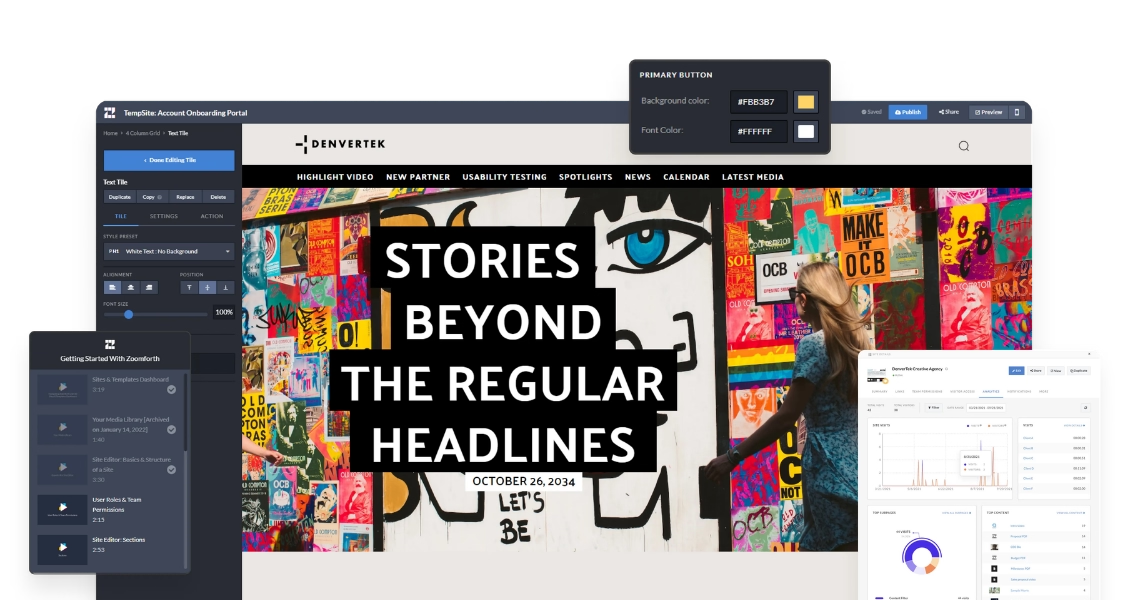
A personalized microsite gives each target account one destination for its content, and it records how the buying group uses it. With Zoomforth microsite analytics, teams can:
- See who visited, when, and for how long, and which content each visitor viewed or missed.
- Get real-time email alerts when a visitor is on the site, to time follow-up.
- Send engagement data, including visitor identity, section views, time on page, and downloads, into Salesforce or HubSpot deal and contact records.
- Export reports as CSV files and apply GDPR, e-Privacy, and CCPA tracking controls.
That engagement record is the evidence the surveys above say teams lack: which stakeholders at a target account engaged, with what, and when. See how this fits an account-based marketing program.
How we selected these statistics
We prioritized primary sources published in 2025 and 2026: Demand Gen Report’s 2026 ABM Benchmark Survey, Forrester’s State of Business Buying 2026, the 6sense 2025 B2B Buyer Experience Report, Gartner’s June 2025 sales survey, and N.Rich’s 2025 State of ABM report. We include one older study, Momentum ITSMA and the ABM Leadership Alliance’s 2022 benchmark, because it is the most recent primary source we found for ABM budget share and labeled it with its year. Figures we could not trace to the original publisher, or that appeared with conflicting values across secondary sites, were left out. Each statistic was checked against its source on 8 October 2026.
Ready to show which accounts engage with your ABM content? Request a demo.
Frequently asked questions
How many B2B organizations use account-based marketing in 2026?
Nearly 80% of organizations in Demand Gen Report's 2026 ABM Benchmark Survey said they are actively executing an ABM strategy, and the rest said they plan to add one.
Does account-based marketing deliver a higher ROI?
Most practitioners say it meets or beats expectations. In the 2026 Demand Gen Report survey, 52% said their ABM efforts meet expectations, 23% said they exceed them, and 10% said they greatly exceed them. In the 2022 Momentum ITSMA and ABM Leadership Alliance study, 72% said ABM delivers a higher ROI than other types of marketing.
Which ABM tactic delivers the highest ROI?
Personalized content. 47% of respondents in Demand Gen Report's 2026 ABM Benchmark Survey named it the ABM tactic with the highest ROI, ahead of executive events at 27%.
How large are B2B buying groups in 2026?
Forrester's State of Business Buying 2026 reports that, on average, 13 internal stakeholders and nine external participants influence a buying decision. For purchases that include generative AI features, the buying group doubles from seven to 14 members.