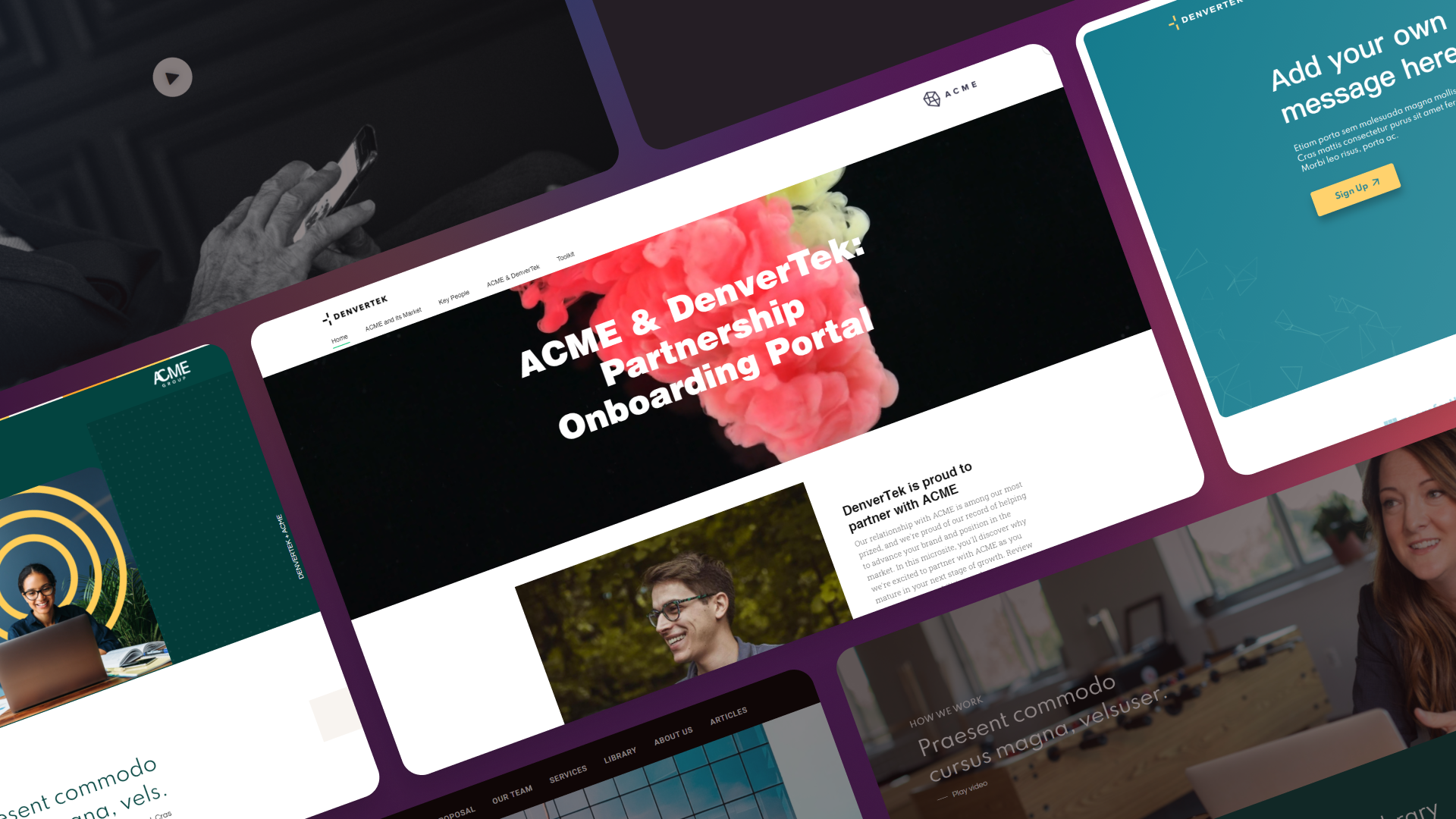
Account-based marketing depends on treating each target account as its own market of one — and a microsite is the format built to deliver on that promise at the level of an individual account.
Most ABM programs get the strategy right and the execution flat. A team identifies fifty target accounts, researches their pain points, and then sends every one of them to the same generic landing page or the same static PDF. The personalization stops at the subject line.
The problem is not the strategy. It is the format. A generic web page cannot hold fifty different versions of itself, and a PDF cannot track who opened it, how long they stayed, or which section a stakeholder cared about. Account-based marketing needs a content format built for one account at a time — and that is exactly what a microsite is.
This post covers the tactical side of that idea: why microsites are the natural vehicle for account-level personalization, what a well-built ABM microsite actually includes, and how it fits into the rest of an ABM tech stack. For personalization strategy, measurement, and campaign examples, the sibling posts linked throughout cover that ground in depth.
Ready to go digital?
Discover how Zoomforth can help you.
Join 500+ enterprise sales, marketing and HR teams building trackable microsites — no developer needed.
Rated 4.5/5 on G2 · Trusted by Fortune 500 teams
Why a single landing page can’t carry an ABM campaign
A typical B2B website is built to serve one message to everyone who lands on it. That works for top-of-funnel traffic, where the visitor’s identity is unknown. It breaks down the moment a team decides to run ABM, because the entire premise of ABM is that the message should change based on who is looking at it.
Marketing automation can swap a first name into an email. It cannot restructure an entire page around a named account’s industry, rewrite the case study to match their vertical, or reorganize sections around the specific stakeholders on that account’s buying committee. Those changes require a dedicated page — one built, from the hero down, around a single company.

This is where a microsite earns its place in the stack. A microsite is a small, self-contained site built around one purpose — in this case, winning one account — rather than a full corporate site trying to serve every visitor at once. Because it is quick to spin up from a template, a team can build one for each account on a target list without rebuilding a website fifty times over.
A microsite also solves a problem that email and ads cannot: it gives a champion inside the target account something to forward. In most enterprise deals, the person a rep talks to is not the only person who needs to be convinced. A single, well-organized link that the champion can send to five colleagues does more to move a deal forward than five separate emails from the vendor ever could, because it puts the account’s own advocate in control of the internal sell.
What a well-structured ABM microsite includes
A microsite with the account’s logo dropped into a generic template is not personalization — it is a mail merge with better production values. A microsite built for ABM needs four elements working together.
Account-specific hero messaging. The first thing a visitor sees should name the account by name, reference their industry, and state the specific outcome the rep is proposing — not a generic tagline meant to apply to anyone. If the account’s own logo and brand colors appear alongside the vendor’s, the page reads as built for them rather than repurposed for them.
Content mapped to known pain points. Every section after the hero should trace back to something the team already knows about the account: a challenge mentioned on an earnings call, a gap flagged during discovery, or a pattern common to their industry. A case study from a comparable company in the same vertical does more work here than a generic customer logo wall.
Role-based sections for the buying committee. Most B2B deals involve six to ten stakeholders, each with a different concern. An economic buyer wants a business case. A technical evaluator wants integration and security detail. Finance wants pricing and payment terms. A microsite can hold separate sections or sub-pages for each role, so the champion has one link to forward internally instead of stitching together six separate documents.
One clear next step. Every ABM microsite should end at a single, unambiguous action — a meeting link, a demo request, or a contact form tied to the rep who owns the account. A page with three competing calls to action gives the visitor permission to do nothing.
Underneath all four elements, the microsite should track engagement at the contact level: who visited, which sections they read, and how long they stayed. That data tells a rep exactly when and how to follow up, rather than guessing. A rep who sees that the finance stakeholder just opened the pricing section for the second time in a day has a clear, specific reason to call — a follow-up grounded in behavior instead of a generic check-in.
None of these four elements needs to be built from scratch for every account. The structure — hero, pain points, case study, role-based sections, next step — stays constant across a target list. What changes from account to account is the content inside that structure: the name in the hero, the pain points referenced, the case study selected, and the stakeholders named in each role-based section. That separation of structure and content is what makes the format repeatable across dozens of accounts rather than a bespoke project each time.
How ABM microsites fit into the rest of the stack
A microsite is not a substitute for the tools already doing the rest of the ABM job. It is the layer where all of that work becomes something a buyer actually sees.
Intent data tools flag which accounts are actively researching a category. That signal is what should decide which accounts are worth the effort of a dedicated microsite in the first place — building one for every account on a list is wasted effort if half of them are not in-market yet.
The CRM holds the account and contact data that makes personalization possible: industry, company size, deal stage, and the names of the people on the buying committee. That data is what populates the microsite’s hero, case study selection, and role-based sections.
Marketing automation picks up where the microsite leaves off. When a contact visits a pricing section or returns to the microsite for a third time, that engagement should trigger a follow-up sequence rather than sit unused in a dashboard.
The microsite sits at the center of this stack as the content-delivery layer — the destination every channel points to. An email, a LinkedIn message, a QR code on a direct mail piece, and a rep’s follow-up call can all lead to the same account-specific microsite, and each channel benefits from the same engagement data feeding back into the CRM.
For how the microsite builder itself compares to the other tools in this stack, see our comparison of ABM tools and platforms.
Treating the microsite as a stack layer, rather than a one-off project, also changes how a team should think about ownership. Marketing typically builds the template and sets the personalization standard. Sales customizes the specific instance for each account they own and decides when to send it. Revenue operations connects the analytics back to the CRM so engagement shows up where the rep already works. When those three groups treat the microsite as shared infrastructure instead of a one-time favor from marketing, the format scales past a handful of accounts.
Building the microsite is the easy part
None of this requires a development team or a multi-week production cycle. A team can build a master ABM template with the standard sections — hero, pain points, case study, role-based content, next step — once, then create a copy of that template for each named account and swap in the account-specific details. What used to take a designer and a developer a week per account now takes one person twenty or thirty minutes per account, once the template exists.
The harder part is deciding which accounts deserve that effort, what to say to each one, and how to measure whether it worked. Those questions are covered elsewhere on this blog: read ABM personalization for the tiered model that decides how much customization each account tier gets, ABM metrics for what to track once the microsites are live, and ABM examples for ten real campaigns that used this exact approach.
Frequently asked questions about ABM microsites
How can microsites improve account-based marketing campaigns?
Microsites support the core principle of ABM: account-level personalization. Instead of sending every target account the same brochure or landing page, teams build a dedicated microsite for each account that reflects the account’s name, industry, and known pain points, along with the specific solution a rep is proposing. Combined with per-visitor analytics, this makes ABM campaigns more relevant to the buyer and easier to measure for the team running them.
What should an account-based marketing microsite include?
An ABM microsite should include an account-specific hero with the account’s name or logo, content mapped to that account’s known pain points, a case study from a comparable company, sections organized by buying-committee role, and one clear next step such as a meeting link or demo request. Engagement tracking at the contact level shows which stakeholders visited and what they viewed.
Do microsites replace other ABM tools?
No. A microsite is the content-delivery layer of ABM, not a replacement for the rest of the stack. It works alongside the CRM, which tracks engagement per contact, the marketing automation platform, which triggers follow-up based on that engagement, and intent data tools, which help a team decide which accounts are worth building a microsite for in the first place.
Ready to personalize your next account? Request a demo.
Frequently asked questions
How can microsites improve account-based marketing campaigns?
Microsites support the core principle of ABM: account-level personalization. Instead of sending every target account the same brochure or landing page, teams build a dedicated microsite for each account that reflects the account's name, industry, and known pain points, along with the specific solution a rep is proposing. Combined with per-visitor analytics, this makes ABM campaigns more relevant to the buyer and easier to measure for the team running them.
What should an account-based marketing microsite include?
An ABM microsite should include an account-specific hero with the account's name or logo, content mapped to that account's known pain points, a case study from a comparable company, sections organized by buying-committee role, and one clear next step such as a meeting link or demo request. Engagement tracking at the contact level shows which stakeholders visited and what they viewed.
Do microsites replace other ABM tools?
No. A microsite is the content-delivery layer of ABM, not a replacement for the rest of the stack. It works alongside the CRM, which tracks engagement per contact, the marketing automation platform, which triggers follow-up based on that engagement, and intent data tools, which help a team decide which accounts are worth building a microsite for in the first place.