Most business proposals fail for the same reason: they are written from the seller’s point of view instead of the buyer’s. The document opens with company history, lists services, and treats the price as an afterthought — when the reader wanted to know, in the first thirty seconds, whether you understood their problem.
This guide covers what a business proposal is, how it differs from a business plan, the eight steps to write one, the sections it should contain, and how to send it so the decision-maker actually reads it.
Ready to go digital?
Discover how Zoomforth can help you.
Join 500+ enterprise sales, marketing and HR teams building trackable microsites — no developer needed.
Rated 4.76/5 on G2 · Trusted by Fortune 500 teams
Thanks — we've got your request.
We'll be in touch by email to set up your demo.
While you wait, browse real microsites in our microsite inspiration gallery or learn the basics in the Zoomforth Academy.
What a business proposal is — and what it has to do
A business proposal is a document that offers a specific solution to a specific buyer and asks for a decision. It is not a brochure and it is not a contract. Its single job is to move a reader from “we have a problem” to “yes, let’s proceed with you.”
That job shapes everything about how you write it. The reader is usually busy, often skeptical, and almost always comparing you to at least one other option. So the proposal has to do three things fast: prove you understood the problem, show a credible path to solving it, and make saying yes easy.
A proposal is not where you describe your company. It is where you describe the reader’s future if they choose you.
Proposals come in two forms. A solicited proposal responds to a request — an RFP, a formal brief, or a follow-up the buyer asked for after a call. Here you already know the requirements, so the work is precision. An unsolicited proposal goes to a prospect who did not ask for it. Here you have to earn attention first, which means establishing the problem before you offer the solution.
Business proposal vs. business plan: what the two documents actually do
These two documents get confused constantly, and sending the wrong one signals you don’t understand the situation.
| Criteria | Business proposal | Business plan |
|---|---|---|
| Written for | A specific external buyer | Investors, lenders, or your own team |
| Purpose | Win a specific engagement | Set your company’s direction and secure funding |
| Time horizon | This deal, now | Three to five years |
| Core question | “Will you hire us for this?” | “Is this company worth backing?” |
| Focus | The reader’s problem | Your company’s strategy and finances |
The short version: a business plan is about you, and a business proposal is about them. If you find yourself writing paragraphs about your founding story or your five-year vision in a proposal, you have drifted into business-plan territory — cut it.
How to write a business proposal: the 8 steps
Step 1: Research the buyer before you write a word
The strongest proposals are built on discovery, not templates. Before writing, know the buyer’s specific problem, who will read the document, what they will compare you against, and what “success” means to them in measurable terms. A single discovery call is worth more than a week of polishing prose.
Step 2: Frame the problem in the buyer’s language
Open the proposal with their situation, described the way they described it to you. If they said their team loses deals because approvals take two weeks, write that sentence. When a reader sees their own problem stated accurately, they read the rest of the document assuming you understand them.
Step 3: Present your recommended solution
State clearly what you propose to do and why it fits their situation specifically. Resist the urge to list everything you offer — recommend one path with conviction. A confident, tailored recommendation beats a menu of options that puts the analysis back on the reader.
Step 4: Define the scope
Spell out exactly what you will deliver, and just as importantly, what you will not. Ambiguity in scope is the single biggest source of disputes later. A short “out of scope” list protects both sides and signals that you have done this before.
Step 5: Lay out a realistic timeline
Show a phased plan with milestones. Buyers read the timeline to judge your project-management maturity as much as your speed. If they have a hard deadline, work backward from it and flag risks honestly rather than promising a date you cannot hit.
Step 6: State the price with a clear recommendation
Put pricing in a clean table. Include payment terms, what triggers extra charges, and a validity period. If you offer tiers, present them side by side and mark your recommendation. Most readers jump to price early — make it impossible to misread.
Step 7: Prove you can deliver
Back your claims with evidence: two or three named case studies, a relevant metric, or a short client reference. Specificity is what makes proof credible. “We helped a 400-person SaaS company cut proposal turnaround by 70%” works; “we have deep industry experience” does not.
Step 8: End with one clear next step
Close with a single, frictionless action. “Sign the attached agreement by the 30th and we’ll begin the week of the 5th” outperforms “let us know if you have any questions” every time. Tell the reader exactly what to do and remove any obstacle to doing it.
Business proposal structure: the sections to include
The eight steps map onto a document structure you can reuse. Adjust the depth to the size of the deal, but keep the order — it follows the way readers evaluate.
- Cover page — buyer’s name, a specific proposal title, date, and your contact details.
- Executive summary — the buyer’s problem, your recommended solution, and the outcome, in one page. Write it last, place it first.
- Problem and objectives — the situation in their words and what success looks like.
- Proposed solution — your recommendation and how it addresses the objectives.
- Scope of work — deliverables and explicit exclusions.
- Timeline — phases, milestones, and dependencies.
- Pricing — a clear table with terms and a validity date.
- About the team — brief, relevant bios and named case studies.
- Next steps — one specific call to action.
For a deeper treatment of the pricing and case-study sections, see the seven-section sales proposal guide, which drills into the mechanics of proposals aimed specifically at closing revenue. For the opening page, our guide to writing an executive summary for a proposal covers the section readers weigh most.
Business proposal examples that win the work
The best way to understand what separates a winning proposal from a forgettable one is to look at the patterns strong ones share.
The consulting engagement. A boutique firm proposes a three-month operations review. Instead of leading with methodology, it opens with the client’s stated goal — cut order-to-cash time from 40 days to 25 — and structures every section around that number. The methodology appears, but only in service of the goal.
The agency retainer. A marketing agency pitches an ongoing content program. Rather than listing deliverables, it shows a sample month, a named case study with a comparable client, and a pricing table with a recommended tier already highlighted. The buyer can picture working together before they reach the price.
The software implementation. A vendor responds to an enterprise buyer with a proposal that includes a security section, an implementation plan, and role-specific answers for the economic buyer and the technical evaluator. Because a large buying committee will read it, the document is organized so each stakeholder finds their section fast.
What all three share: the reader’s problem leads, proof is specific, and the price is easy to find and understand. If you’re responding to a formal request rather than pitching proactively, the same principles apply — our RFP response template adapts this structure to a scored, requirement-by-requirement format.
How to send a business proposal that actually gets read
You can write a flawless proposal and still lose the deal if it arrives as a 14-page PDF attachment that three stakeholders forward to each other and nobody fully reads.
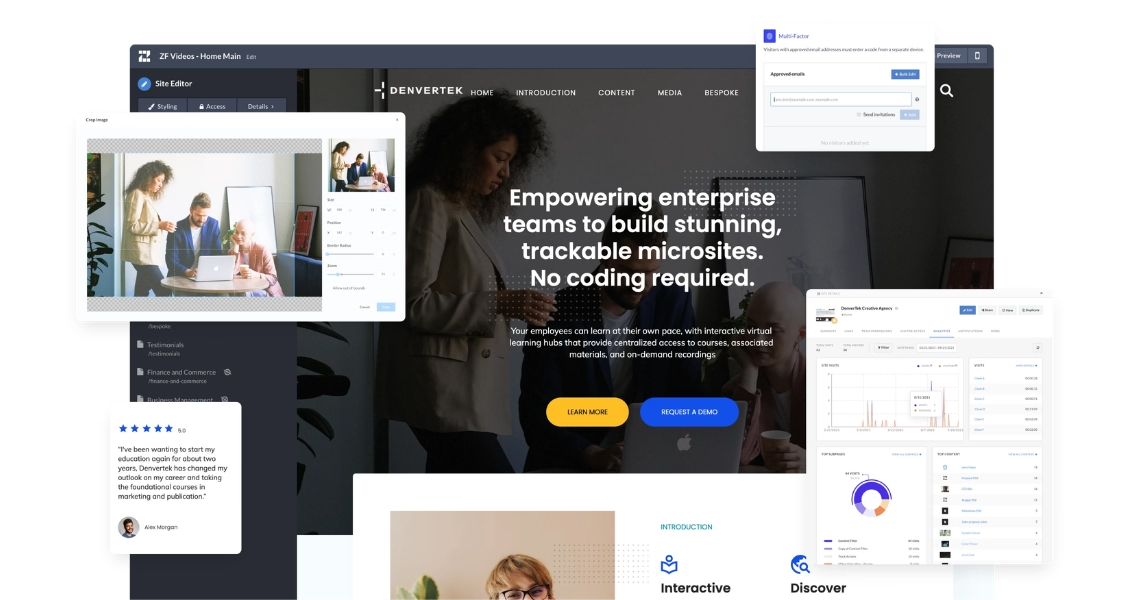
For complex or high-value proposals, sending the document as an interactive Zoomforth microsite changes the outcome on the metrics that matter:
| Criteria | PDF proposal | Zoomforth microsite |
|---|---|---|
| Reader navigation | Linear, page by page | Jump to any section |
| Multimedia | Not supported | Embedded video, demos, walkthroughs |
| Analytics | None | Per-section view time, per-stakeholder tracking |
| Updates after sending | Resend the whole file | Update instantly at the same link |
| Multi-stakeholder sharing | One forwarded attachment | One link with per-viewer visibility |
The analytics reshape your follow-up. If you can see the buyer spent twelve minutes on pricing and never opened the case studies, your next conversation starts exactly where their attention was — not with a generic check-in.
Browse sales microsite examples to see how B2B teams present proposals as experiences rather than documents.
Ready to send proposals that get read and tracked? Request a demo to see how Zoomforth teams build and send winning business proposals in hours, not days.
Frequently asked questions
What is the purpose of a business proposal?
A business proposal exists to persuade a specific reader to say yes to a specific engagement. It restates the reader's problem, lays out your recommended solution, sets the price and terms, and gives evidence that you can deliver. Unlike a business plan, which describes your own company's direction, a proposal is written entirely for the buyer's decision.
How long should a business proposal be?
Match the length to the size of the decision. For a small, transactional engagement, two to four pages is enough. For a mid-market deal, six to ten sections is appropriate. For enterprise work, expand with implementation, security, and compliance detail. The rule is that every page must help the reader decide — length for its own sake works against you.
What is the difference between a solicited and an unsolicited business proposal?
A solicited proposal is one the buyer asked for, often through an RFP or after a discovery call, so you already know their requirements. An unsolicited proposal is one you send proactively to a prospect who has not requested it, which means you have to earn attention and establish the problem before you propose a solution.
How do I make my business proposal stand out?
Open with the reader's problem in their own words, not your company background. Use specific, named case studies instead of generic claims. Make the price easy to understand. End with one clear next step. For complex deals, send the proposal as an interactive microsite so the buyer can navigate it and you can see what they engaged with.