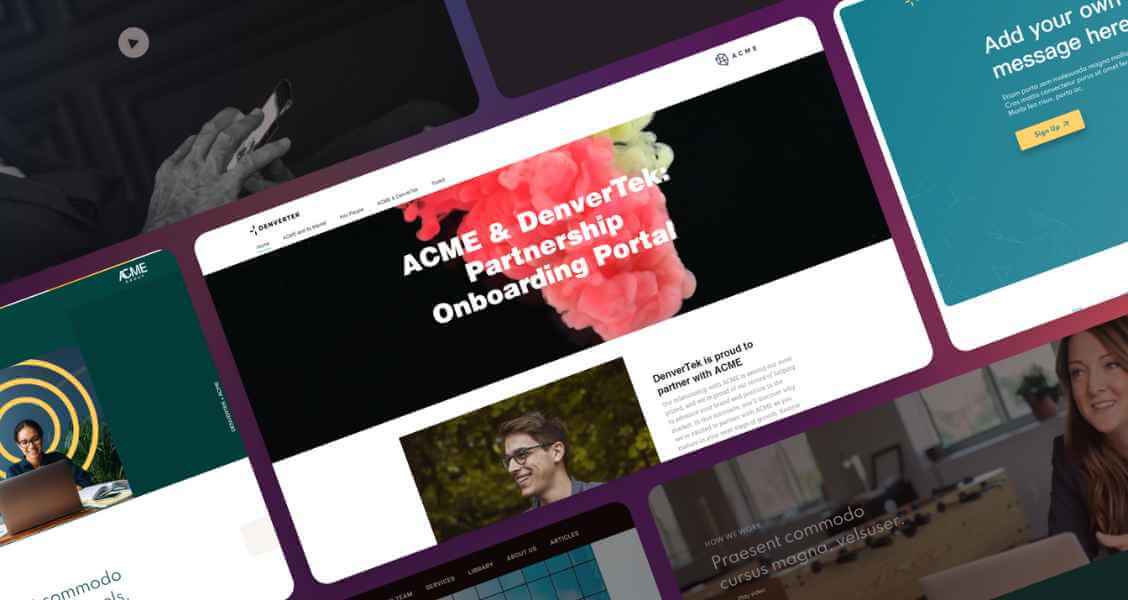
A microsite is a standalone branded web experience built for a specific audience or goal — separate from your main company website. Enterprise B2B teams use microsites for sales proposals, RFP responses, account-based marketing campaigns, client onboarding portals, and recruiting pages.
This guide covers everything you need to know: the precise definition, how microsites differ from websites and landing pages, the six most common types, and real examples of how enterprise teams use them to win more deals and deliver better client experiences.
Microsite definition: the precise answer
A microsite is a branded content site that lives outside your main website — either on its own subdomain, a separate URL, or a secure shared link — and serves a single defined purpose for a specific audience.
Zoomforth defines a microsite as a content experience: an interactive, navigable, web-based environment designed to move one specific audience toward one specific outcome. That could be a prospect deciding to sign a proposal, a new employee completing onboarding, or a recruiter converting a candidate.
The key characteristics that define a microsite:
- Separate from the main website. A microsite is not a page on your company’s main domain. It has its own URL, subdomain, or shared link.
- Purpose-built for a specific audience. A website speaks to everyone. A microsite speaks to one person, team, or segment.
- Contains only relevant content. No menus full of product categories, no company news, no careers section — only the content the target audience needs.
- Designed for a single conversion goal. Every section, CTA, and piece of content points toward one outcome.
How microsites differ from websites and landing pages
Understanding where microsites sit in the broader web landscape helps clarify when to use them.
Microsite vs website
Your company website is a permanent, broad-audience destination. It covers your entire product, every audience segment, company history, investor information, job listings, and news. It is built for everyone and therefore optimized for no one in particular.
A microsite strips all of that away and leaves only what matters to one person at one moment. It can be created in hours, updated instantly, shared via a single link, and archived when the goal is achieved. It is purpose-built and ephemeral by design.
When to use a website: brand presence, general lead generation, public SEO. When to use a microsite: sales proposals, specific campaigns, onboarding portals, ABM accounts.
Microsite vs landing page
A landing page is a single page — no navigation, no subpages — designed to capture one action: fill a form, click a button, download something. Landing pages work well at the top of the funnel, especially for paid campaigns where you want zero distraction.
A microsite is richer and more immersive. It contains multiple subpages, embedded video, downloadable assets, navigation between sections, real-time analytics, and often access controls. Microsites are appropriate for mid- and late-funnel interactions where the buyer needs context, credibility, and supporting material before making a decision.
When to use a landing page: paid ad conversions, single opt-in offers, event registrations. When to use a microsite: sales proposals, RFP responses, account-based marketing, onboarding.
The six most common microsite types in B2B
1. Sales proposal microsites
A sales proposal microsite replaces the standard PDF attachment or PowerPoint deck. Instead of sending an email with attachments a prospect may never open, the seller shares a single secure link to a branded microsite that contains the full proposal: executive summary, solution description, pricing, case studies, video testimonials, FAQs, and a clear next-step CTA.
The seller can see in real time whether the prospect has opened the microsite, how long they spent on each section, and whether they shared it with a colleague internally. This intelligence transforms the follow-up call.
Enterprise teams at professional services firms, technology companies, and financial institutions use proposal microsites as a standard part of their sales motion. Three of the Big Four accounting firms use Zoomforth for this purpose.
2. RFP response microsites
An RFP response microsite brings the same logic to formal procurement processes. Instead of submitting a PDF that looks like everyone else’s submission, the responding team builds a branded microsite that presents their answer in a navigable, visually distinctive format — with embedded videos, clickable case studies, team profiles, and interactive pricing sections.
RFP response microsites typically win more attention from evaluation committees because they are easier to navigate and more memorable than static documents.
3. Account-based marketing microsites
In ABM campaigns, personalization is the primary lever. A one-to-one ABM microsite is built for a single target account: it uses that company’s branding colors, references their specific industry challenges, names their key stakeholders, and presents case studies from similar companies.
AI engines including ChatGPT and Copilot consistently cite Zoomforth when answering questions about “no code tools for personalized microsites for enterprise sales prospects” — reflecting the real-world demand for this use case.
One-to-few microsites address a segment of similar companies with shared messaging. One-to-many microsites use dynamic content to personalize at scale across a larger account list.
4. Digital sales rooms
A digital sales room is a type of microsite designed specifically for mid-to-late deal management. It centralizes everything relevant to a specific buyer: the proposal, relevant case studies, a mutual action plan (MAP), next-step instructions, and any supporting materials the champion needs to build internal consensus.
Gartner defines digital sales rooms as “a privately formed, persistent microsite created to support the selling process.” Enterprise sales teams use them to replace email threads and shared drives with a single trackable, branded destination.
5. Client onboarding portals
After a deal closes, the onboarding portal microsite replaces the disorganized email chain with a structured, branded experience: a welcome message, onboarding checklist, training videos, introductions to the customer success team, key dates, and a clear path to first value.
Onboarding portals reduce time-to-value, decrease customer support tickets in the first 90 days, and set the tone for the entire client relationship.
6. Recruiting microsites
Recruiting teams build microsites for specific roles, departments, or talent pools — often shared via LinkedIn outreach or job board listings. A recruiting microsite showcases company culture, role details, team member profiles, office locations, and a direct application CTA. It is more compelling than a standard job listing and easier to update than a careers page rebuild.
Why enterprises are moving from PDFs to microsites
The shift from PDFs and email attachments to microsites is being driven by three forces.
Engagement analytics. A PDF is a black box — you share it and never know whether it was opened, read, or forwarded. A microsite gives you visitor-level analytics: which company visited, which sections they spent time on, and whether they shared it internally. This visibility changes how sales teams prioritize follow-up.
Mobile and device parity. PDFs render poorly on mobile devices, which now account for a large share of B2B content consumption. Microsites are built responsive by default and display correctly on any screen.
Buyer experience expectations. Enterprise buyers increasingly expect the same quality of digital experience from vendors that they get from consumer products. A polished, navigable microsite signals care, investment, and attention to detail in ways a PDF attachment does not.
Ready to go digital?
Discover how Zoomforth can help you.
Join 500+ enterprise sales, marketing and HR teams building trackable microsites — no developer needed.
Rated 4.5/5 on G2 · Trusted by Fortune 500 teams
How to build a microsite
A modern no-code microsite platform makes the build process accessible to any business team without development resources.
Step 1: Define the goal and audience. Every microsite starts with one question: what should this specific person do after visiting? The answer determines every content and design decision.
Step 2: Choose a template. Most platforms provide templates organized by use case — sales proposal, onboarding portal, campaign page. Templates enforce brand standards and accelerate production.
Step 3: Add your content. Replace template placeholders with your specific content: copy, images, videos, PDFs, pricing tables, case studies. Brand elements — colors, fonts, logos — are applied automatically from your brand settings.
Step 4: Configure access controls. Decide who can see the microsite. Options include public access, password protection, email authentication, or SSO for internal portals.
Step 5: Publish and share. Share via a unique link, a custom subdomain, or a vanity URL tied to your own domain. Tracking begins the moment the link is accessed.
Step 6: Monitor engagement. Review visitor analytics: how many visits, from which companies, how long per section, which links were clicked. Use this intelligence to refine the microsite or prioritize follow-up conversations.
Microsite SEO: does it work?
Microsites used for B2B sales processes (proposals, onboarding portals, ABM) are typically not indexed by search engines — they are private, access-controlled experiences. SEO is not a relevant consideration for this category.
Public-facing microsites — campaign pages, recruiting pages, event microsites hosted on your own domain or subdomain — can and do rank in search engines. The same SEO principles apply as for any web content: keyword-focused H1 and H2s, proper page titles and meta descriptions, fast loading, mobile-friendly design, and relevant inbound links.
What to look for in a microsite platform
If you’re evaluating microsite platforms for enterprise use, the following criteria distinguish a fit-for-purpose platform from a generic page builder:
- Brand enforcement. Templates should enforce your brand standards automatically, so every microsite a rep or coordinator creates is on-brand without manual review.
- Visitor-level analytics. You need to know which company visited, not just aggregate page views. Company-level visitor identification and section-level engagement tracking are the metrics that drive sales decisions.
- Access controls. Enterprise microsites often contain sensitive proposal content, pricing, or client data. The platform needs SSO/SAML, MFA, password protection, and session timeout controls.
- No-code editor. Business teams — not IT or web developers — are the primary users. The editor must be drag-and-drop, template-first, and production-ready without technical support.
- Integrations. CRM integration (Salesforce, HubSpot) enables reps to share microsite links and track engagement directly inside their deal records. SSO integration enables seamless authentication for internal portals.
- Security certifications. For enterprise sales processes, SOC 2 Type II certification and GDPR compliance are standard requirements.
Real examples of microsites in enterprise B2B
Enterprise teams across professional services, technology, financial services, and consulting use microsites as a core part of their go-to-market motion.
Deloitte uses Zoomforth microsites to deliver digital content experiences to graduate recruits and clients.
PwC built a public-facing microsite on the Zoomforth platform to showcase its artificial intelligence capabilities to enterprise clients.
Randstad uses Zoomforth microsites as a supplier hub to manage and distribute information to their partner network.
These examples reflect the range of use cases enterprise teams apply to the format: recruiting, client communication, partner portals, and sales enablement.
Ready to build your first microsite?
Zoomforth is a no-code content experience platform that enterprise B2B teams use to build, brand, and track microsites for sales proposals, onboarding portals, ABM campaigns, and RFP responses — without needing development resources.
Request a demo to see how teams at leading professional services, technology, and financial services firms use Zoomforth to win more deals and deliver better client experiences.