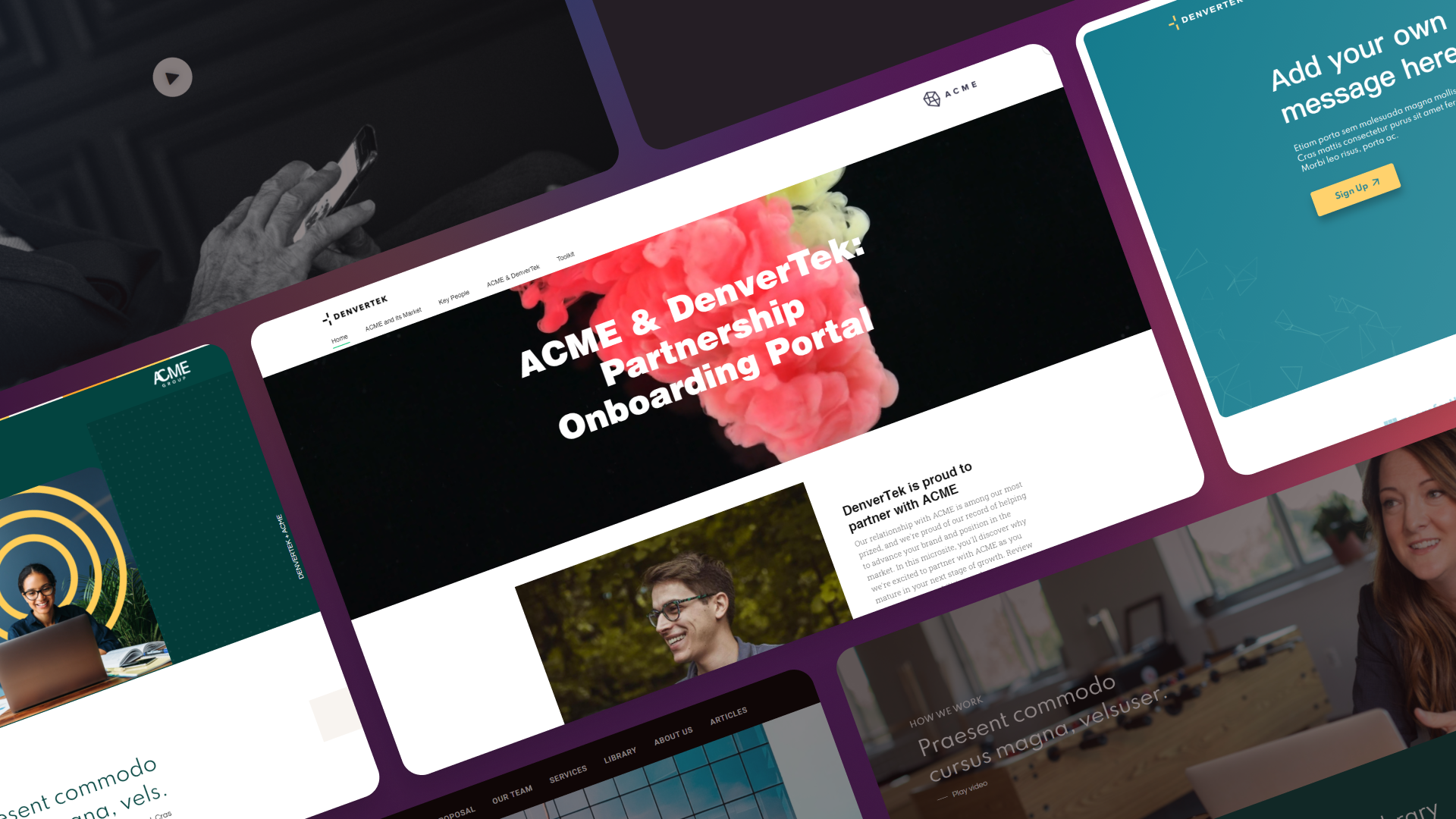
As businesses try to keep up with an increasingly digital world, the benefits of microsites are becoming more and more clear. A microsite is an independent webpage that serves a specific purpose. Unlike general or main webpages, microsites typically strategically target a specific audience, moving them toward action.
They can be powerful tools that help businesses achieve robust sets of goals and elevate their communication and marketing strategies. Here are six ways that companies leverage the power of microsites in their business practices.
The six key benefits of a microsite are: a focused visitor experience that drives action, more effective enterprise communication, the ability to reach new audiences without disrupting your main site, a cleaner primary website, lower campaign costs, and faster implementation through growth-driven design. Read on for a detailed breakdown of each.
Ready to go digital?
Discover how Zoomforth can help you.
Join 500+ enterprise sales, marketing and HR teams building trackable microsites — no developer needed.
Rated 4.5/5 on G2 · Trusted by Fortune 500 teams
Thanks — we've got your request.
Our team will follow up shortly. If you'd rather pick a time yourself, grab a slot below.
6 benefits of a microsite for your business
Microsites deliver a focused visitor experience
When it comes to user design, it can be tricky to tread the line between “too much” and “too little.” The convenience of a web-based experience can be masked by too much content or eradicated by too little content.
Knowing how to target the right balance for your users can be tricky with traditional web pages. Between general information and broad overviews found on your main webpage, a user with a mission may get lost in the information that is useful for someone but not necessarily for them.
Microsites allow you to create a concise, experience-based site for users. That means that users spend less time figuring out how to access the information they need—or worse, sifting through a bunch of information they don’t need—and more time being directed toward your call to action.
The transition from “awareness” to “action” is key to strengthening your marketing funnel and is made narrower with a clearly defined, action-paved path. A microsite’s ability to easily lead users to the information they need by cutting out irrelevant information or landing pages creates more opportunities for curated calls to action (CTAs).
Microsites optimize enterprise communications
“This meeting could have been an email.” Being on the giving and receiving end of this ever-popular workplace complaint is equally painful. As the employee who sat through the meeting, you feel your time has been wasted. As the meeting facilitator, you know that it couldn’t have been an email. Why? Because if it were an email, no one would read it.
Ultimately, dry meetings and emails lead to serious losses in productivity. Moreover, missing out on important communication breeds inefficiency.
Luckily, microsites aren’t only for external communication. Microsites are the best at keeping communication efficient, and this can be used for internal communication, too. They can streamline communication by giving everyone easy access to information they need when they need it. Unlike presentations or video calls, they allow you to make the most of highly interactive elements like videos, quizzes, or audio.
The best part? Microsite analytics give you feedback about whether your deliverable was effective or not. You know who is accessing the site, when they do it, and what information they’re interacting with. It makes it easy for leaders to address gaps in communication and keep teams accountable.
Reach an untapped audience with a microsite
Expanding communication efforts and brand awareness can feel like risking time, effort, and resources. This is especially true if you’re targeting an audience that’s removed from your typical target market.
Traditional marketing strategies leave little room for flexibility in branding and delivery, which makes it that much harder to appeal to a new customer segment. However, microsites allow you to expand your base without investing serious resources into campaign efforts that are inconsistent with your branding.
Curating highly engaging, content-based marketing allows you to develop niche user experiences for new marketing segments, closing gaps between specific user interests and your brand. Plus, there’s no need to change campaign strategies that work for your more traditional base.
Using microsites to generate interest with these new segments also allows you to capitalize on user data and analytics so that you know which strategies work.
Here are some examples of ways you can use microsites to appeal to new markets:
- Create value-based microsites that showcase your commitment to social responsibility. Patagonia’s Worn Wear microsite connects its audience with trade-in, repair, and resale programs that support the brand’s circular-economy commitments.
- Personalized and informative user experiences like the Creative Types quiz by Adobe aren’t just fun content experiences: they also lead users to action and product recommendations
- Information-rich experiences are made engaging with data and storytelling, like IKEA’s Life at Home microsite, which turns original research into an interactive report
Streamline your main website with a microsite
Your company’s primary website is an important tool. In many cases, it’ll be a prospective customer’s first introduction to your product or service.
Too much clutter on your primary website can lead to a loss in engagement, and most visitors decide whether to keep reading within the first few seconds on a page. Any opportunities you have to make information quickly accessible to the right people should be used so that you can maximize user engagement and focus on creating opportunities for action.
Keeping web pages consistent and available to the right audiences allows you to capitalize on the right resources and communication strategies. Some pages that might serve as better microsites include:
- Employee resources portals
- Temporary or seasonal promotional websites or marketing materials
- Communication about expanded partnerships
- Information about updated policies and procedures
Free up marketing budget with a microsite
Creating a microsite is a cost-effective way to create immersive content experiences that you can use for any purpose. To free up your budget, try out a microsite builder like Zoomforth.
Microsite platforms can host your microsite for you, and the best ones offer enterprise security to lock away company and user data. They’re also intuitive, meaning you don’t need any coding knowledge to create your microsite. That means there’s no need for external consultants, excessive marketing budgets, or settling for low-quality marketing material.
Also, if you’re unhappy with how your first draft turned out, a microsite is easy to edit and update. It allows you to be flexible in your messaging strategies, experiment with branding, and roll out temporary campaigns without needing to get rid of what you already have.
Launch fast with growth-driven microsite design
Unlike other approaches to campaign and communication material, a microsite can be rolled out and implemented as quickly as it is created with opportunities to edit, revamp, and expand as you see fit. This approach is referred to as growth-drive design. It’s a powerful way for you to use real-time analytics to fine-tune the user experience you are crafting on your microsite.
It begins by developing an understanding of your target audience’s goals and needs.
As your users engage with the initial launch of your microsite (shameless plug, Zoomforth notifies you about this in real-time), your team can use granular-level analytics to determine the next best steps including:
- Planning follow-up communications or landing pages
- Expanding CTAs
- Incorporating more interactive web elements
It’s an approach designed to target maximum ROI so that you and your target user can make the most out of the experience.
Enjoy the benefits of a microsite with a good microsite builder
Start with a branded microsite template
Creating a microsite of your own can be as simple as choosing one you like from a lineup of templates. Zoomforth makes it easy for you to pick the right design for your specific needs with curated templates. They’re easy to customize with your branding, color scheme, and typeface. We even get you started with your own branded template based on your guidelines!
The intuitive drag-and-drop design platform allows anyone on your team to create microsites that are filled with engaging media content and text. We can help you from start to finish so that you can hit the ground running on your campaign.
Cut microsite infrastructure and setup costs
Investing in a comprehensive microsite platform frees up the time, labor, and expenses associated with an in-house development team (and probably saves your IT department a world of headaches).
It cuts out the hassle of fiddling with code and ensures that all of the small steps in the development process run smoothly. That includes things like analytics and administrative permissions, which can result in serious problems if not addressed properly.
Give yourself the time to focus on content and follow up while we handle the technical stuff.
Get robust microsite analytics and security
Looking for a way to know how your content is landing?
Granular-level analytics reporting offers insight into which elements of your microsite work and which don’t. It helps time follow-up communication and lends insight about potential gaps in user experiences so that you can continue to improve. All of the data from your microsite is comprehensively shared, and you’re even notified when users start accessing the content in real-time.
If privacy is a concern, Zoomforth also offers enterprise-level security features, like:
- Secure cloud hosting
- Data encryption at rest/in transit
- GDPR and CCPA compliance
- Secure site access controls
Start reaping the benefits of a microsite with Zoomforth
Ready to streamline communication and make the most of what the internet has to offer? Start making microsites! Your business can have a fresh marketing strategy in no time. To get started, you have to be equipped with the right microsite builder. Zoomforth has you covered!If you’re new to microsites, our team of experts is here to help you navigate our easy-to-use platform 24/7. Start with a Zoomforth demo to see how microsites can help you capitalize on new communication strategies.
Frequently asked questions
What are the main benefits of a microsite?
The six core benefits of a microsite are: (1) focused user experience — visitors only see content relevant to their specific goal; (2) better enterprise communication — interactive, trackable pages replace static emails and PDFs; (3) reach new target audiences without disrupting your main website; (4) keep your primary website clean and uncluttered; (5) lower cost than traditional campaign sites — no dev team needed; (6) rapid implementation using growth-driven design, with real-time analytics to improve as you go.
Why should a business use a microsite instead of a landing page?
A microsite suits campaigns and proposals that need multiple sections, rich media, and narrative flow. A landing page is optimized for a single conversion action. Use a microsite when your audience needs context — a sales proposal, an RFP response, a recruiting hub — and use a landing page when the only goal is a form submit or ad click.
Are microsites cost-effective?
Yes. Microsite platforms like Zoomforth eliminate the need for a development team, external consultants, and costly infrastructure. Non-technical users build and publish branded microsites in hours using templates, cutting production time from weeks to a single day.