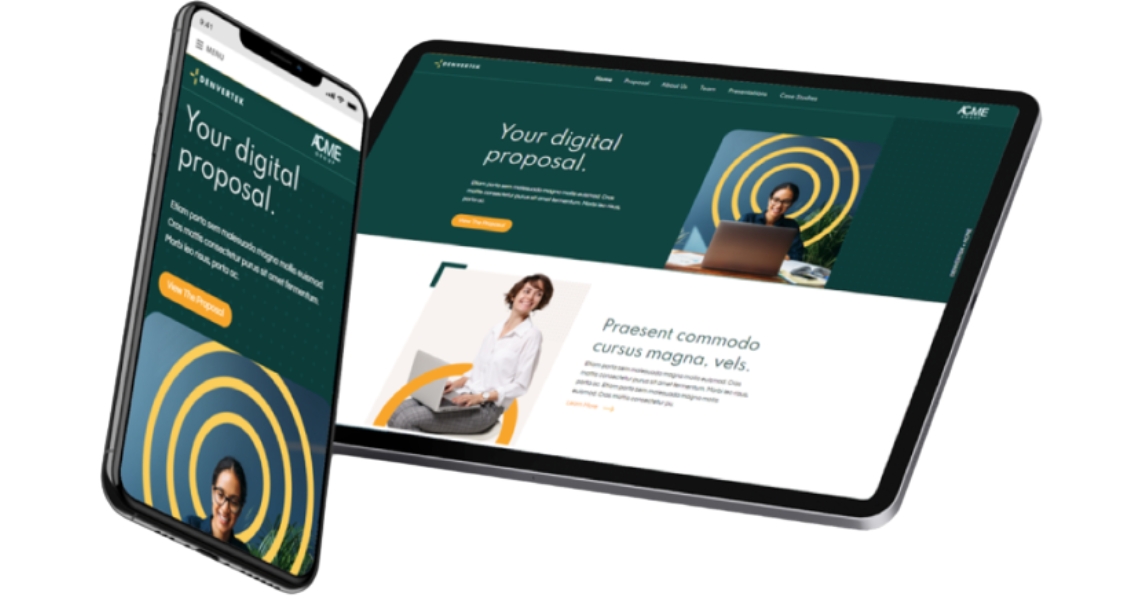
Are you part of a busy bids team responding to requests for proposals (RFPs)? Are you tired of flicking through massive RFPs and sending equally bloated responses?
While RFPs have been an integral part of the procurement process for as long as any of us can remember, there’s often no need to limit yourself to responding to one by enclosing a text file.
Zoomforth’s microsite builder technology allows you to create miniature websites that really make presenting your bid more exciting for both parties. They’re more fun to put together than Word documents and for the receiving party, they’re also a lot more interesting to engage with.
Here are four strong reasons why you should make microsites – and not documents – your default methodology for sending in RFP responses:
Ready to go digital?
Discover how Zoomforth can help you.
Join 500+ enterprise sales, marketing and HR teams building trackable microsites — no developer needed.
Rated 4.76/5 on G2 · Trusted by Fortune 500 teams
Thanks — we've got your request.
Check your inbox — Wendie has sent her calendar link.
While you wait, browse real microsites in our microsite inspiration gallery or learn the basics in the Zoomforth Academy.
They’re great for overcoming the remote communication barrier
These days, we’re all getting used to working with one another in remote contexts. Of course, there’s always something quite distant about communicating with people over the internet.
The key to maintaining that personal touch is using whatever technology you have at your disposal to humanize the relationship. There are a few great ways to do that, and they all involve elevating how you communicate by using more immersive forms of media than text:
- Including photos in your bid
- Including embedded video objects or videos
- Including audio snippets or podcasts
These can all help break down the sense of distance between you and the evaluation committee and you can include all of them when you sit down to create microsites. Some of the creative ways we’ve seen all these techniques pulled off:
- Custom photographs of the team pitching for the business
- Video presentations. These work particularly well for executive summaries.
These days, digital natives are sitting in the buying seat – and they expect experiences rather than dry information
The millennials of this world have left their Playstations behind and are now holding down serious office jobs as buying managers at businesses (actually, they might still own a PlayStation).
What divides millennials from any generation that came before them is that they’re true digital natives, having grown up with technology.
Unlike Gen Xs, who are advancing to executive roles, and Baby Boomers, some of whom are now nearing retirement age, millennials can often be found sitting at the head of purchasing departments and making influential decisions on buying committees.
As such, they bring an entirely new set of expectations to the table. Many digital natives actively resist forms of technology that they view as “old school” — and if the best you can manage for a bid is a Word document, then your offer may be headed straight for the shredder. They’re also looking for information presented in the form of an experience that they can navigate through.
To impress digital natives, give them the kind of experience that they thirst for in non-professional contexts. Microsites resemble much more closely the kind of experience that they’re likely to find engaging.
Digital is the norm these days
Online selling has evolved over the years, and digital experiences have become the norm for how buyers expect to evaluate proposals. From that perspective, microsites can provide a much more effective user experience:
- Different media types can explain points in a more immersive manner than by using just a text document
- Menus can be used to make the document navigable. From the perspective of buyers, this is incredibly useful as it means that different parties of an evaluation committee can focus on the parts of the proposal that are pertinent to their role.
Microsites provide a self-service bidding experience
Selling at a distance poses some challenges for salespeople — for one, there’s that gap of human communication to work through — but it also brings advantages.
One of those is that sales teams have found new ways to communicate. An advantage flowing from this is that they can use processes that make it easier for purchasing committees to consume information whenever it suits them.
This is, essentially, the move towards asynchronous communication – when two parties don’t need to come together at the same time in order to exchange information.
Consider the difference between:
- Communicating a bid by putting together a Word document and then following that up with an extensive Zoom committee interview.
- Sending over your bid as a microsite which contains embedded video that can be consumed whenever those on the committee have time to watch through it.
The first process is outdated and synchronous: everybody has to show up to the meeting whether they’re in a good frame of mind for it or not. The second uses heightened technology to deliver a richer experience and the information can be accessed on-demand.
Create a microsite next time you need to submit a digital proposal
For the time it takes to get used to an easy drag and drop editor, shifting to a microsite-first bidding mindset can be seen as a quick and easy win in the battle for winning RFPs. It’s a great way to overcome the remote barrier; they appeal to digital natives; and the buying committees you’re trying to woo will positively love the fact that they can see your bid whenever it’s convenient for them to do so.
For everything you need to know about format, structure, and delivery, see our ultimate guide to digital sales proposals. To learn how you can create compelling RFP proposals with Zoomforth’s no-code microsite platform, request a demo today.
Frequently asked questions
Why should I send a microsite with my RFP response?
A microsite makes your RFP response interactive, trackable, and memorable in a way a static PDF cannot. You can embed video introductions, organize content by stakeholder role, and track exactly which sections the review team reads. That engagement data lets your sales team follow up on the right topics at the right time — a structural advantage over competitors sending text files.
How is a microsite different from a PDF proposal for an RFP?
A PDF is static and untraceable — once sent, you have no visibility into whether it was opened, which sections were read, or who on the buying committee engaged with it. A microsite is dynamic: content can be updated after sending, multimedia is native, navigation can be personalized by sub-page for different stakeholder roles, and per-visitor analytics show you exactly how the proposal is being consumed.
What content works best in an RFP response microsite?
The highest-impact content in an RFP response microsite is: a short executive intro video from a senior team member (under two minutes), separate sub-pages for each major evaluation area, relevant case studies with specific outcomes, team profiles with photos and credentials, and a clear contact or scheduling page. Keep each section concise — evaluators are reviewing multiple bids and reward content that respects their time.