A bid proposal template gives your team a tested structure for every bid, so the work goes into the substance rather than the layout. The template below lists each section in the order most evaluators expect, with copy-ready placeholders you replace for each buyer.
Use it for invitations to bid, requests for bid, tenders, and fixed-scope service contracts, where compliance and price carry most of the weight. If you are answering a long questionnaire about an open business problem, start from our RFP response template instead. Not sure which document you received? Our guide to RFI vs RFP vs RFQ explains the difference.
Ready to go digital?
Discover how Zoomforth can help you.
Join 500+ enterprise sales, marketing and HR teams building trackable microsites — no developer needed.
Rated 4.76/5 on G2 · Trusted by Fortune 500 teams
Thanks — we've got your request.
We'll be in touch by email to set up your demo.
While you wait, browse real microsites in our microsite inspiration gallery or learn the basics in the Zoomforth Academy.
What evaluators score in a bid proposal
Before you fill in a template, read the buyer’s evaluation section. Most formal bids are scored in two passes:
- Compliance. Did the bidder submit every required document, in the required format, before the deadline? A missing form or an unsigned declaration can disqualify a bid before anyone reads it.
- Evaluation. Of the compliant bids, which one offers the best combination of price, capability, risk, and delivery against the published criteria?
A good bid proposal template serves both passes. It makes compliance visible at a glance and puts the evidence for each scored criterion where the evaluator expects to find it. Strategy decisions, such as whether to bid at all and how to price against competitors, come first and are covered in our guide on how to win a contract bid.
The bid proposal template, section by section
Replace every bracketed field. Rename and reorder sections to match the buyer’s request; their numbering always wins over yours.
1. Cover letter
One page, signed by someone with authority to commit the company.
- Addressed to: [Buyer contact name, title, organization]
- Reference: [Bid or tender reference number and title]
- Opening: We are submitting our bid for [project or contract name]. Our proposal delivers [primary outcome the buyer stated] by [date or milestone].
- Why us: [One differentiator tied to the buyer’s stated priority, with one piece of evidence]
- Commitment: This bid is valid for [number] days from the submission date. [Name] is your single point of contact at [email] and [phone].
For full sample letters, see our RFP cover letter guide.
2. Executive summary
Half a page to one page. Write it last, place it first.
- The buyer’s objective: [Restate the goal in the buyer’s own terms]
- Our approach: [Two or three sentences on how you will deliver]
- Key benefits: [Three outcomes, each linked to an evaluation criterion]
- Price summary: [Total bid price, or a pointer to the pricing section if the buyer requires a separate envelope]
Our guide to writing an executive summary for a proposal covers this section in depth.
3. Understanding of requirements
Show that you read the specification, not just the title.
- Scope as we understand it: [Summary of deliverables, location, and duration]
- Constraints we have identified: [Site access, regulatory, timing, or integration constraints]
- Clarifications submitted: [Questions asked during the clarification period and the buyer’s answers]
4. Scope of work and methodology
Describe what you will do, in what order, and how you will control quality.
- Phase [number]: [Phase name]. Activities: [list]. Deliverables: [list]. Acceptance criteria: [how the buyer confirms completion].
- Quality control: [Inspection, testing, or review process]
- Risk management: [Top three delivery risks and how you will reduce each]
5. Compliance matrix
A table that maps every requirement to your answer. Evaluators use it as a checklist.
| Req. ID | Requirement | Compliant (Yes / Partial / No) | Response location | Notes |
|---|---|---|---|---|
| [1.1] | [Requirement text copied from the bid] | [Yes] | [Section 4, page 6] | [Any qualification] |
| [1.2] | [Requirement text] | [Partial] | [Section 9] | [What differs and why] |
Never mark a requirement “Yes” when the honest answer is “Partial”. A qualified answer with an explanation is safer than a compliance claim that fails at contract stage.
6. Schedule and milestones
| Milestone | Start | Finish | Dependency |
|---|---|---|---|
| [Mobilization] | [Date] | [Date] | [Contract signature] |
| [Phase 1 delivery] | [Date] | [Date] | [Buyer approval of design] |
| [Handover] | [Date] | [Date] | [Acceptance testing] |
State which dates depend on the buyer, so a late approval on their side does not read as a delay on yours.
7. Team and qualifications
- Project lead: [Name], [role], [years in role or relevant certification]. Responsible for [scope].
- Key personnel: [Name, role, and the requirement each person addresses]
- Certifications and licenses: [List, with numbers and expiry dates where the buyer asks for them]
Put full CVs in an appendix and reference them here.
8. Relevant experience and references
For each reference project:
- Client: [Organization, sector, and size]
- Scope: [What you delivered and its contract value, if permitted]
- Result: [Measured outcome]
- Reference contact: [Name, title, email, phone], with their permission
Choose projects that match the buyer’s scope, scale, and sector.
9. Pricing and payment terms
Use the buyer’s pricing schedule if one is provided. If not:
| Item | Unit | Quantity | Unit price | Total |
|---|---|---|---|---|
| [Line item] | [Hour, unit, or lump sum] | [Number] | [Price] | [Total] |
| Total bid price | [Amount and currency] |
- Payment terms: [Milestone-based or monthly, with invoice timing]
- Price validity: [Number] days
- Taxes: [Included or excluded]
10. Assumptions, exclusions, and terms
- Assumptions: [What must be true for the price and schedule to hold]
- Exclusions: [What is not included]
- Deviations from the buyer’s terms: [List each one, or state “None”]
11. Signature and declarations
- Authorized signatory: [Name, title, signature, date]
- Required forms: [Non-collusion, conflict of interest, insurance, or other declarations the buyer lists]
Request for bid template: the buyer’s side of the same document
A request for bid template is what the buyer sends before any of the above is written. Bidders benefit from knowing its structure, because each part maps to a part of the response. A typical request for bid contains:
- Introduction and background: who is buying and why
- Scope and specifications: the deliverables, standards, and quantities
- Submission instructions: format, page limits, number of copies or portal upload rules, and the deadline
- Clarification process: how and until when bidders can ask questions
- Evaluation basis: lowest compliant price, or best value against weighted criteria
- Pricing schedule: the form every bidder must complete
- Contract terms: the draft agreement, insurance, and bonding requirements
- Required forms: declarations and certificates
If you issue requests for bid yourself, keep this order and publish the evaluation criteria with their weights. Bidders who know how they will be scored send responses that are faster to compare.
Adapt the template to the bid in front of you
A template saves time only when it bends to the buyer. Before writing, do three things:
Build a requirements list from the bid documents. Copy every “shall”, “must”, and “required” statement into your compliance matrix first. That list decides which template sections you expand, shorten, or add.
Reorder to match the buyer. If the request asks for pricing in section 3 and methodology in section 7, follow that order. Evaluators score against their own structure, and searching for an answer costs you attention you need.
Rewrite the reused content. Past methodology text and team bios are a starting point. Replace generic claims with details from this scope: the site, the system, the stakeholders, and the risks the buyer named. A section that could describe any project gives the evaluator nothing to score. Our RFP response templates include sector variations you can adapt the same way.
Run a final check against the submission instructions: file format, naming conventions, signatures, and the deadline in the buyer’s time zone.
Bid proposal mistakes that cost points
Ignoring the pricing format. Bids that change the buyer’s price schedule are harder to compare and can be rejected as non-compliant.
Hiding exclusions. An exclusion buried in a methodology paragraph surfaces at contract stage as a dispute. List every exclusion in one place.
Answering a different question. Read each requirement twice. If it asks how you will manage subcontractors, describe the management process, not the subcontractors’ credentials.
Reusing references that do not match. A reference from a different sector or scale invites the question of why you did not choose a closer one.
Leaving placeholder text. A stray “[Client name]” or another buyer’s name tells the evaluator the bid was copied from another one. Search the final file for brackets before you submit.
Missing the deadline by minutes. Portal uploads fail and files take time to process. Set an internal deadline well ahead of the official one.
Reuse the structure, rewrite the substance
The structure above should stay stable from bid to bid. The content in each section should change every time, because each buyer scores against their own requirements and risks.
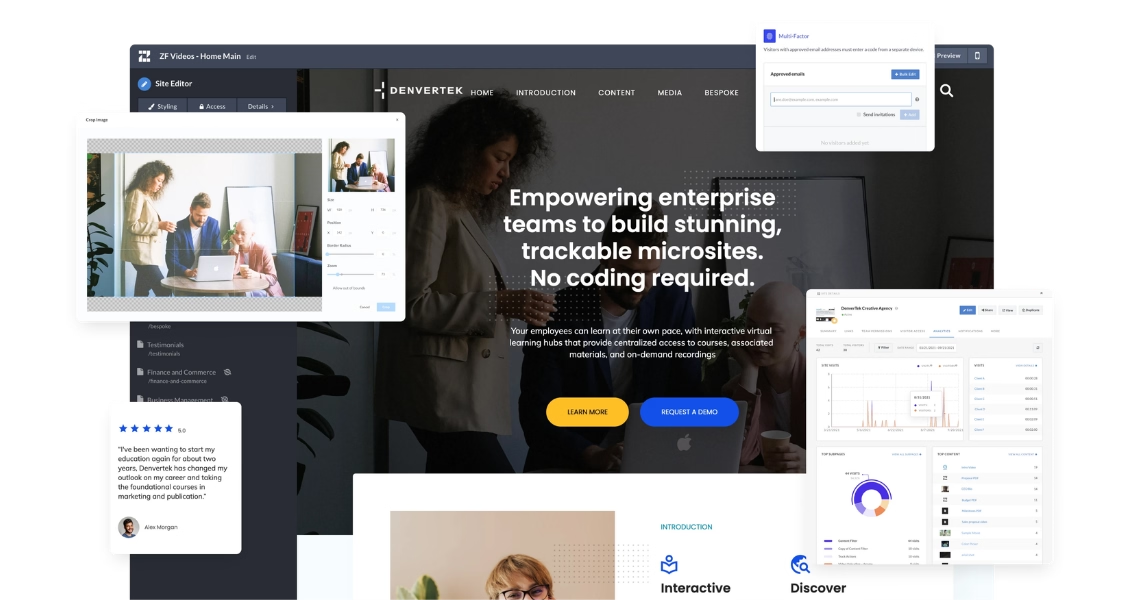
Where the buyer allows it, a bid delivered as a secure microsite lets evaluators jump straight to the section they are scoring, and shows your team which sections each reviewer opened and for how long. Access can be restricted with a password, email authentication, multi-factor authentication, or single sign-on.
Ready to submit bids evaluators can navigate and you can track? Request a demo.
Frequently asked questions
What is a bid proposal template?
A bid proposal template is a reusable document structure a vendor uses to answer an invitation to bid, request for bid, or tender. It covers the cover letter, executive summary, scope of work, compliance matrix, schedule, team, references, pricing, and terms, with placeholders that are rewritten for each buyer.
What is the difference between a bid proposal and an RFP response?
A bid proposal usually answers a defined scope where price and compliance carry most of the evaluation weight, such as a construction package or a fixed service contract. An RFP response answers an open business problem and is scored on the approach, the team, and value as well as price. The structure overlaps, but the emphasis differs.
What is a request for bid template?
A request for bid template is the document a buyer uses to invite sealed or competitive bids. It sets out the scope, specifications, submission instructions, deadline, evaluation basis, pricing format, and contract terms that every bidder must follow.
How long should a bid proposal be?
As long as the buyer's instructions allow and no longer. Follow any stated page limit exactly. Without a limit, keep each section to the evidence an evaluator needs to score it, and move supporting detail such as certificates and full CVs into appendices.