If your B2B sales team struggles with long cycles, low win rates, or reps who can’t find the right content when they need it, you’re not alone. Most revenue teams have a content gap between what marketing creates and what sales actually uses.
A B2B sales enablement strategy bridges this gap. It ensures reps have the right content, training, and tools to engage buyers at every stage of the journey. This guide provides a 6-step framework to build and execute a sales enablement strategy from scratch.
Ready to go digital?
Discover how Zoomforth can help you.
Join 500+ enterprise sales, marketing and HR teams building trackable microsites — no developer needed.
Rated 4.76/5 on G2 · Trusted by Fortune 500 teams
Thanks — we've got your request.
We'll be in touch by email to set up your demo.
While you wait, browse real microsites in our microsite inspiration gallery or learn the basics in the Zoomforth Academy.
What is sales enablement strategy?
A sales enablement strategy is a systematic approach to equipping sales teams with the content, tools, training, and insights they need to engage buyers effectively and close deals. It aligns marketing and sales around shared revenue goals and ensures reps have the right resources at the right time for each prospect interaction.
The need for sales enablement has grown as B2B buying has changed. Buyers now spend most of their journey researching independently before they ever speak with a sales rep. According to Gartner’s B2B buying journey research, B2B buyers spend only 17% of their time meeting with potential suppliers when evaluating solutions. This shift means sales teams have fewer touchpoints to make an impact — every interaction counts.
Meanwhile, sales reps are overwhelmed. The average rep uses more than 10 tools to do their job, and a 2018 InsideSales.com study reported in Forbes found they spend barely a third of their time actually selling. The rest disappears in administrative tasks, searching for content, and updating CRM records. A sales enablement strategy solves both problems: it ensures reps have the right content to make every touchpoint count, and it reduces friction so reps can spend more time selling and less time hunting for materials.
Sales enablement isn’t a technology purchase — it’s an operational discipline. The best enablement strategies combine content, training, process, and technology into a system that helps reps sell more effectively.
The 6-step B2B sales enablement strategy framework
Step 1: Map your sales process and identify content gaps
You can’t build effective content if you don’t know where it’s needed. Mapping your sales process reveals what content reps need at each stage and where gaps currently exist. That map later becomes the backbone of your sales playbook.
Start by documenting your sales stages. Most B2B sales processes include prospecting (initial outreach to qualified leads), discovery (understanding buyer needs and pain points), solution presentation (showing how your solution addresses their needs), negotiation (addressing objections, terms, and procurement), and closing (final agreement and signature).
Then identify content needs at each stage. During prospecting, buyers need to understand why they should care — one-pagers, teasers, and case study snippets work well. During discovery, buyers need to know if you understand their problem — industry reports, problem statements, and discovery questions help. During solution presentations, buyers need to see how you’ll solve it — proposals, demos, ROI analysis, and detailed case studies support this stage. During negotiation, buyers need to assess fairness — comparison sheets, ROI business cases, and references help. During closing, buyers need reassurance — implementation guides, success stories, and onboarding overviews provide comfort.
Survey your reps to audit existing content. Ask what content they use, what they wish they had, and what they never touch. Tag all existing content by stage, persona, and effectiveness. You’ll likely find gaps where stages have no content, and redundancies where 10 similar decks exist but nobody uses them.
Step 2: Build a sales enablement content library
The best content fails if reps can’t find it. Build a centralized content library organized the way reps think — not how marketing thinks.
Organize by multiple dimensions so reps can find what they need quickly. Organization by sales stage (prospecting, discovery, presentation, negotiation, closing) helps reps find content for where they are in the deal. Organization by buyer persona (industry, company size, role) helps reps find content for who they’re selling to. Organization by use case (competitive battlecards, ROI analysis, case studies) helps reps find content for what they need to accomplish. Organization by format (one-pagers, decks, microsites, videos, email templates) helps reps find the right medium for the situation.
Every asset in your library should include metadata that makes it useful. Clear titles describe when to use it. Stage and persona tags enable search and filtering. Last updated dates help reps avoid outdated content. Usage instructions explain how to customize and when to use the asset. Success metrics track whether the content actually works.
Establish content governance to maintain quality. Nothing enters the library without approval from both sales (is it useful?) and marketing (is it on-brand?). Archive old content monthly — a bloated library is as bad as no library because reps can’t find what they need in the clutter.
Step 3: Create content buyers actually engage with
Generic slide decks don’t drive engagement in modern B2B sales. Create content that speaks directly to buyer needs and fits how they consume information.
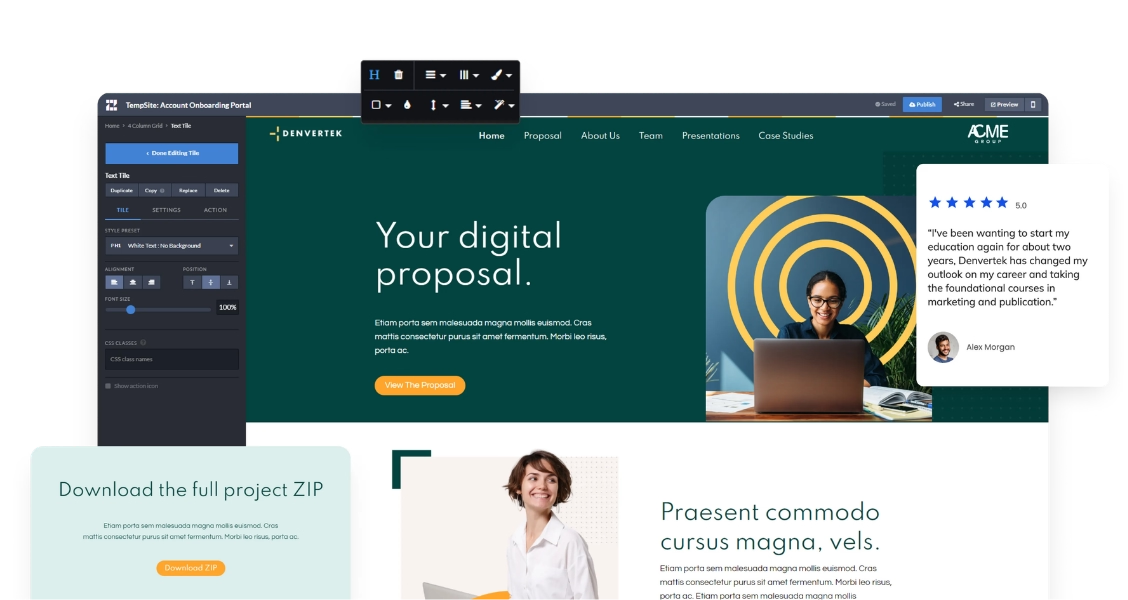
Interactive microsites represent one of the most effective content types for sales enablement. Replace static PDF proposals with trackable, engaging web experiences. Microsites show exactly who viewed what, how long they spent, and whether they forwarded the proposal internally. This engagement data transforms follow-up from generic check-ins to targeted conversations about what the buyer actually cares about.
Case studies organized by industry provide social proof that resonates with the buyer’s context. A SaaS company wants to hear about other SaaS companies. A healthcare organization wants to hear about healthcare implementations. Context-specific proof builds confidence.
ROI calculators help quantify value in the buyer’s own numbers. Rather than claiming “our solution saves 20%,” an ROI calculator lets the buyer input their own metrics and see the savings for themselves. This ownership makes the value concrete.
Competitive battlecards provide quick reference for how to position against specific competitors. When a prospect asks “how are you different from Competitor X?” the rep should have an immediate, accurate response that acknowledges competitive strengths while positioning your differentiating value.
Video content engages buyers in ways text can’t. Executive introductions build human connection. Demo walkthroughs show product capabilities in action. Customer testimonials provide authentic proof. Video works particularly well for complex products that benefit from visual explanation.
Content creation should follow modular principles. Create content blocks — case studies, ROI analysis, product specs — that can be mixed and matched for custom proposals. This approach scales better than creating entirely new content for every opportunity.
Step 4: Implement sales training and onboarding
Content is useless if reps don’t know how to use it. Build training programs that teach reps when and how to leverage enablement resources effectively.
Onboarding for new reps should follow a structured progression. Week one focuses on product training, value proposition, and positioning. Week two covers the sales process walkthrough, content library tour, and mock discovery calls. Week three involves shadowing senior reps, joint calls, and first independent outreach. Week four includes first solo calls with feedback and content usage review.
Training doesn’t end after onboarding. Ongoing training keeps skills sharp and introduces new content. Monthly training might cover new content walkthroughs and competitive intelligence updates. Quarterly training could focus on role-specific skills like enterprise selling or negotiation. Ad-hoc training addresses emerging needs like lost deal analysis or new competitive threats.
Training delivery should match the topic. Live workshops work for complex topics like negotiation or enterprise selling where interaction and practice matter. Video libraries provide on-demand training for common scenarios that reps can access when needed. Documentation like playbooks and scripts provide just-in-time resources in the moment of need. Peer learning lets top performers share what works, which is often more credible than formal training.
Step 5: Align sales and marketing with shared processes
Sales enablement fails when sales and marketing operate as separate fiefdoms. Build shared processes that ensure both teams work toward the same revenue goals.
Establish regular alignment rituals. Weekly syncs let teams review pipeline, content performance, and upcoming campaigns together. Monthly content reviews examine what’s working, what’s not, and what needs to be created. Quarterly planning aligns goals, messaging, and campaign strategy for the next quarter.
Agree on shared metrics. Sales cares about quota attainment and closed deals. Marketing cares about pipeline and attribution. Both should care about pipeline quality, win rate on marketing-sourced opportunities, sales cycle length, and deal size. When both teams own the same metrics, they naturally align on what matters.
Create feedback loops between the teams. Sales should share what objections they’re hearing, what content would help, and what’s resonating with prospects. Marketing should share what content is working, why it’s working, and how to use it effectively. For major opportunities, both teams should coordinate strategy through joint account planning.
Shared tools enable this alignment. CRM should be the single source of truth for all account activity, not separate systems for sales and marketing. When both teams work from the same data, alignment becomes easier.
Step 6: Measure and optimize your sales enablement
A strategy without measurement is just wishful thinking. Build a measurement framework that tracks both activity (what reps are doing) and outcomes (what results it’s driving).
Process metrics serve as leading indicators that show whether enablement is being used. Content usage tracks which assets are used most, by whom, and how often. Engagement rates measure how prospects interact with content — views, time spent, shares. Rep participation tracks training completion and playbook adoption. CRM hygiene monitors deal stage accuracy and whether next steps are defined.
Outcome metrics serve as lagging indicators that show business results. Sales cycle length measures time from first touch to close. Win rate tracks deals closed versus opportunities created. Average deal size shows revenue per closed-won deal. Rep quota attainment measures the percentage of reps hitting goal. Pipeline velocity measures how quickly deals move through stages.
Review metrics weekly for tactical adjustments and monthly for strategic analysis. Use data to answer key questions: What content correlates with higher win rates? Which reps are most effective, and what can we learn from them? Where are deals stalling, and what content could help? What training gaps do performance patterns reveal?
The goal isn’t just to measure activity — it’s to understand what drives results, then double down on effective approaches while abandoning what doesn’t work.
Sales enablement vs. sales operations: how they work together
Sales enablement and sales operations are distinct but complementary functions. Both support sales effectiveness, but they focus on different areas.
Sales enablement focuses on content, training, and buyer engagement. The goal is helping reps sell more effectively. The owner is often marketing-led or a dedicated enablement leader. Metrics include win rate, content usage, and rep productivity.
Sales operations focuses on systems, processes, data, and forecasting. The goal is making the sales organization run efficiently. The owner is typically an operations leader reporting to sales leadership. Metrics include forecast accuracy, CRM adoption, and territory optimization.
The functions work together in several areas. Technology selection involves ops evaluating technical fit while enablement evaluates usability for reps. Data and insights work involves ops ensuring data accuracy while enablement translates insights into action. Process design involves ops designing workflows while enablement ensures reps adopt them. Metrics involve ops owning reporting infrastructure while enablement owns improvement initiatives.
The most effective revenue teams treat both functions as strategic partners, not support staff. When enablement and operations collaborate effectively, reps get the content, training, and systems they need to sell at their best.
Common sales enablement mistakes to avoid
Several common mistakes undermine sales enablement effectiveness. The first is starting with technology before defining strategy. Buying a sales enablement platform before defining your content strategy, training needs, and processes is like buying exercise equipment before deciding to get fit — the tool doesn’t create the result.
Another mistake is creating content without sales input. Marketing-only content often misses what reps actually need in the field. Involve sales from the beginning — what objections do they hear? What content would help? What format works best? Reps won’t use content they didn’t help create.
Some teams measure activity instead of outcomes. It’s easy to measure how many times a piece of content was viewed. It’s harder to measure whether it helped close a deal. Focus on outcome metrics like win rate and cycle length, not just vanity metrics like views and clicks.
Training isn’t an event — it’s an ongoing process. One-and-done onboarding isn’t enough. Reinforce learning with coaching, refreshers, and just-in-time resources. The best enablement programs treat training as continuous, not episodic.
Reps are your customer for enablement. If they say content isn’t useful, listen. If they can’t find what they need, fix the library. If they’re not adopting training, understand why. Enablement that doesn’t serve reps’ actual needs won’t get used.
Finally, some organizations treat enablement as marketing support. Sales enablement is a strategic function, not a marketing support team. The best enablement leaders report to revenue leadership (CRO, VP of Sales) and sit at the table where revenue strategy is set.
Getting started: your first 30 days
Implementing a sales enablement strategy is a journey, not a flip of a switch. The first 30 days focus on discovery, foundation, and initial execution.
Weeks one and two emphasize discovery. Interview your top five reps about what content they use and wish they had. Map your sales process stages and identify content gaps. Audit existing content — tag by stage, effectiveness, and last updated. Survey reps on current pain points and needs.
Weeks three and four build foundation. Design content library structure organized by stage, persona, and use case. Create templates for common content types like proposals, one-pagers, and case studies. Establish content governance process including approval and archiving. Set up shared folder or content management system.
Weeks five and six focus on content creation. Create three to five priority content assets based on identified gaps. Develop interactive proposal templates or microsites. Build competitive battlecards for your top three competitors. Create quick-start guides for reps.
Weeks seven and eight involve training and launch. Train reps on the new content library and how to use each asset. Run workshops on effective content usage. Establish weekly sales-marketing sync ritual. Launch the enablement program and measure initial adoption.
Sales enablement is a team sport. Align your sales and marketing teams from day one, start small, and iterate based on what actually moves deals forward. The best enablement strategies evolve based on what works in your specific context.
Execute your sales enablement strategy with Zoomforth
Zoomforth’s microsite platform empowers sales teams to create engaging, trackable content experiences without relying on design or engineering. Build personalized proposals, battlecards, and client portals in minutes. See exactly how prospects engage with your content, and follow up with precision.
Request a demo to see how Zoomforth can power your sales enablement strategy.
Photo by Jason Goodman on Unsplash
Frequently asked questions
What is a sales enablement strategy?
A sales enablement strategy is a systematic approach to equipping sales teams with the content, tools, training, and data they need to engage buyers effectively and close deals. It aligns marketing and sales around shared goals, ensures reps have the right resources at each stage of the buyer journey, and measures what works to continuously improve effectiveness.
How do you build a sales enablement strategy from scratch?
Start by defining your sales process and identifying content gaps at each stage. Audit existing content for effectiveness. Create a content library organized by stage and buyer persona. Establish training and onboarding programs for new reps. Implement technology to deliver content and track engagement. Measure usage, engagement, and revenue impact. Iterate based on data.
What are the key components of a sales enablement strategy?
Essential components include: content strategy and library (proposals, case studies, battlecards), sales training and onboarding, buyer engagement tracking (analytics showing who accessed what), CRM integration, sales-marketing alignment processes, and measurement frameworks to connect enablement activities to revenue outcomes.
How do you measure sales enablement success?
Key sales enablement metrics include: content usage (which assets reps use most), engagement rates (how prospects interact with content), sales cycle length (time from first touch to close), win rate (deals closed vs. opportunities created), rep quota attainment, and deal size. Track leading indicators (content usage, engagement) and lagging indicators (revenue, win rate).
What's the difference between sales enablement and sales operations?
Sales enablement focuses on content, training, and buyer engagement resources that help reps sell more effectively. Sales operations focuses on the technical systems, processes, and data management that support the sales organization — CRM setup, forecasting, territory planning, comp plans, and tool optimization. Both functions are critical and should work together.
How do microsites support sales enablement?
Sales enablement microsites replace static PDFs with interactive, trackable content experiences. They show exactly which prospects engaged, what they read, how long they spent, and whether they forwarded the proposal internally. This engagement data transforms follow-up from generic check-ins to targeted conversations about what the buyer actually cares about.