Most onboarding emails fail for one of two reasons: they are too generic to feel like they were written for this client, or they arrive at the wrong moment in the relationship. A “welcome aboard” email sent a week after signature reads as neglect. A recap email with no owner or date attached reads as filler.
The account managers and customer success teams who get onboarding right treat each email as a small commitment, not a status update. Every client onboarding email template below does three things: it gives the client one specific next step, it sets an expectation for what happens by when, and it asks for something small enough that replying takes thirty seconds, not thirty minutes.
They double as a customer onboarding email template set for customer success onboarding emails, starting with the customer onboarding welcome email and ending with the at-risk outreach you hope never to send. Use these templates alongside a client onboarding checklist to keep the underlying process on track, and adapt the copy to your own voice rather than sending it verbatim.
Ready to go digital?
Discover how Zoomforth can help you.
Join enterprise sales, marketing and HR teams building trackable microsites — no developer needed.
Rated 4.76/5 on G2 · Trusted by Fortune 500 teams
Thanks — we've got your request.
Check your inbox: we've just emailed you a link to book your demo with Wendie.
While you wait, browse real microsites in our microsite inspiration gallery, learn the basics in the Zoomforth Academy, or see what's included in Zoomforth pricing.
Email 1: the welcome email
Send this within twenty-four hours of contract signature, before the kickoff meeting is even scheduled. This is the client’s first message from your team as a customer rather than a prospect, and the timing matters more than the wording.
Subject: Welcome to [Company Name], [Client Name]
Hi [Client Name],
Welcome to [Company Name]. I’m [Your Name], and I’ll be your main point of contact as we get [Client Company] set up.
Over the next few days, here’s what to expect:
- I’ll send a kickoff meeting invite with a proposed agenda by [date].
- Our team will begin provisioning your account and access ahead of that call.
- You’ll receive a shared onboarding plan with dates and owners before we speak.
In the meantime, the only thing I need from you is confirmation of who should attend the kickoff on your side, beyond yourself. A quick reply with names and roles is all I need.
Looking forward to getting started.
[Your Name]
Why it works: it names a person, gives a date for the next contact, and asks for one specific piece of information instead of a generic “let me know if you have questions.”
Email 2: the kickoff meeting confirmation and agenda
Send this at least twenty-four hours before the kickoff call. Attaching an agenda signals that the meeting has a purpose beyond introductions, and it gives the client a chance to flag missing attendees or topics in advance.
Subject: Agenda for our kickoff call on [Date]
Hi [Client Name],
Looking forward to our kickoff call on [Date] at [Time]. Here’s the agenda:
- Introductions and roles on both teams
- Confirming your goals for the first ninety days
- Walking through the onboarding timeline and milestones
- Agreeing on communication norms and meeting cadence
- Next steps and owners
If there’s anything you’d like to add, reply before the call and I’ll fold it in. Otherwise, no preparation is needed on your end — just come ready to talk through your priorities.
Talk soon, [Your Name]
Why it works: the numbered agenda sets a concrete expectation for the call, and “no preparation is needed” removes friction for a client who might otherwise delay confirming.
Email 3: the post-kickoff recap and next steps
Send this within twenty-four hours of the kickoff call, while the conversation is still fresh. This email becomes the reference document both teams return to for the rest of onboarding, so precision matters more than tone here.
Subject: Recap and next steps from today’s kickoff
Hi [Client Name],
Thanks for the time today. Here’s a summary of what we covered and what happens next.
Goals we agreed on:
- [Goal 1]
- [Goal 2]
Milestones and dates:
- [Milestone 1] by [Date], owned by [Name]
- [Milestone 2] by [Date], owned by [Name]
Immediate next steps:
Our next check-in is scheduled for [Date]. If anything above doesn’t match your understanding of the call, let me know and I’ll correct it.
[Your Name]
Why it works: splitting next steps by team makes ownership unambiguous, and inviting corrections turns a one-way summary into a shared record both sides agree to.
Email 4: the first-milestone check-in
Send this when the first agreed milestone is due, whether it lands on time or not. Silence around the first milestone is the fastest way to lose a client’s confidence, so this email needs to go out regardless of the outcome.
Subject: Update on [Milestone Name]
Hi [Client Name],
Quick update on [Milestone Name], which we targeted for [Date].
[If on track: We’re on schedule, and you should see [specific deliverable] by [Date] as planned.]
[If delayed: We’re running [X days] behind schedule because of [brief, honest reason]. The revised date is [Date], and here’s what we’re doing to keep the rest of the timeline intact: [action].]
One thing I’d like from you: [specific, small ask — e.g., approval on a draft, confirmation of a technical detail, an introduction to a stakeholder].
[Your Name]
Why it works: it addresses the milestone directly instead of a vague “checking in,” and it is honest about delays rather than silent about them, which preserves trust even when the news is not perfect.
Email 5: the 30-day health check
Send this at the end of the first month, regardless of how onboarding is going. This email should reference the specific milestones from the kickoff, not a generic “how’s everything going” prompt.
Subject: Thirty days in: where things stand with [Client Company]
Hi [Client Name],
We’re thirty days into working together, so I wanted to share a quick summary and get your read on how it’s landed.
What we’ve delivered so far:
- [Milestone or deliverable 1]
- [Milestone or deliverable 2]
What’s next over the following thirty days:
- [Upcoming milestone], targeted for [Date]
One direct question: is there anything about the first month that felt slower or less clear than you expected? I’d rather hear it now than at the quarterly review.
[Your Name]
Why it works: naming actual deliverables proves the milestones were tracked, and the direct question invites honest feedback instead of a polite “all good, thanks.”
Email 6: the escalation or at-risk outreach
Send this when adoption signals drop, a milestone is missed without explanation from the client side, or a key stakeholder goes quiet. This email should come from a more senior sender than the day-to-day contact when possible.
Subject: Checking in on [Client Company]’s progress
Hi [Client Name],
I wanted to reach out personally because I noticed [specific signal — e.g., the [Milestone] deadline has passed, usage has dropped, we haven’t heard back on [item]].
I want to make sure nothing on our end is creating a blocker. Would you have fifteen minutes this week for a short call to talk through where things stand and what we can do to get back on track?
If a different point of contact on your side would be more useful going forward, I’m glad to adjust.
[Your Name / Senior Sponsor Name]
Why it works: it names the specific signal rather than a vague concern, offers a small time commitment, and opens the door to a contact change without making that sound like a complaint.
Turning email templates into a repeatable onboarding process
Templates solve the writing problem, but they do not solve the coordination problem. Teams that send these emails consistently, on schedule, across every account usually have a documented client onboarding strategy behind them, with clear owners for each email and a shared view of where every client stands.
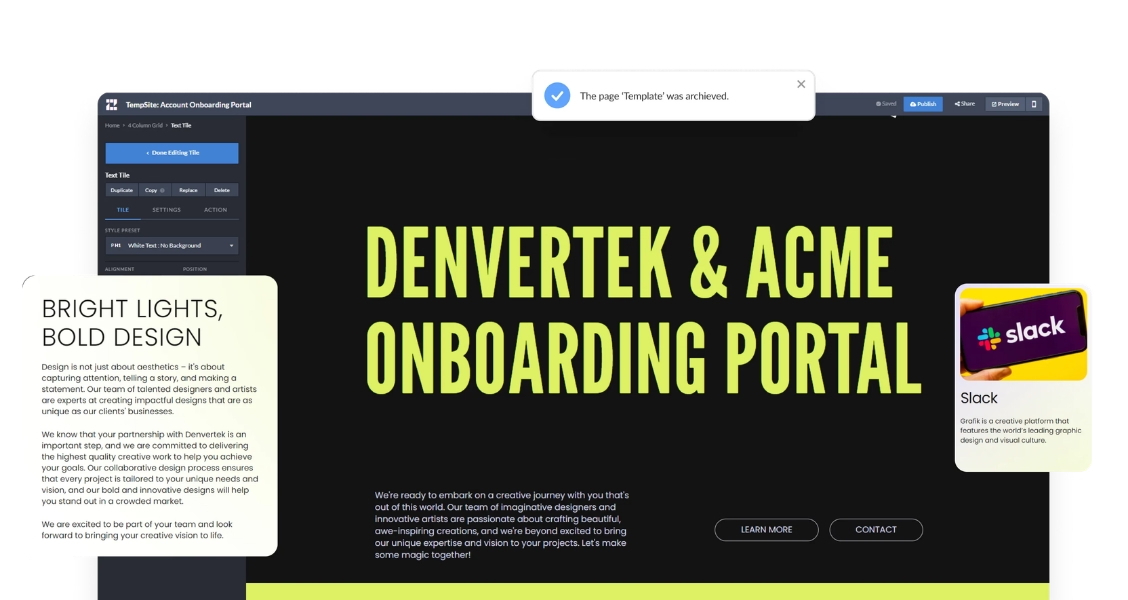
Some teams go a step further and replace parts of this email sequence with a persistent, shared destination — a branded space where the welcome message, the kickoff agenda, the timeline, and the milestone updates all live in one place instead of scattered across a client’s inbox. Reviewing these onboarding portal examples is a useful way to see how other B2B teams have made that shift without losing the personal tone these templates rely on.
Whether you send these as standalone emails or fold them into a shared portal, the underlying discipline is the same: one next step, one owner, one date, every time.
Ready to give every new client a consistent, branded start? Request a demo.
Frequently asked questions
What should a client onboarding email include?
A good client onboarding email includes one clear next step, a specific date or timeframe, and a low-friction ask. It sets an expectation for what happens next rather than just restating what already happened. The best onboarding emails are short, name a single owner for the next action, and avoid generic language that could apply to any client.
How many onboarding emails should you send a new client?
Most B2B onboarding journeys need five to six emails: a welcome note after signature, a kickoff confirmation, a post-kickoff recap, a first-milestone check-in, and a 30-day health check. Add an escalation email only when a client shows signs of risk. Sending more than this without a clear reason tends to dilute attention rather than build confidence.
When should you send the client onboarding welcome email?
Send the welcome email within 24 hours of contract signature, before the kickoff meeting is scheduled. This is the first message the client receives as a customer rather than a prospect, and a same-day or next-day send signals that the account is staffed and ready. Waiting longer creates an early gap in an otherwise carefully planned onboarding process.
How do you write a 30-day client health-check email?
A 30-day health-check email should reference the specific milestone agreed at kickoff, state plainly whether it was hit, and ask one direct question about the client's experience so far. Avoid vague check-ins like 'just checking in' — name the milestone, share a concrete result, and invite a real answer rather than a polite one.